Protests Erupt in Minneapolis After ICE Shooting, Challenging Trump Administration’s Immigration Narrative
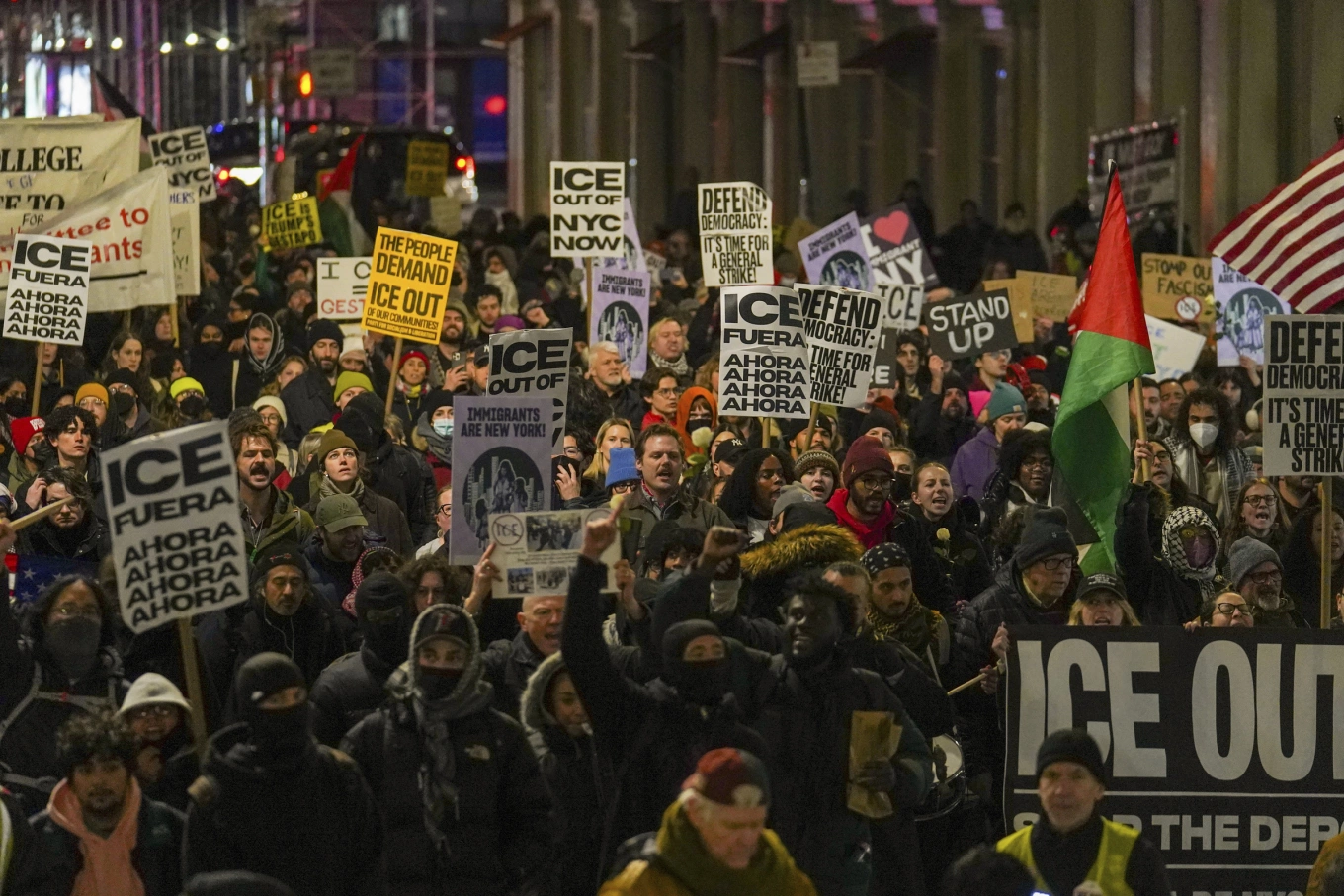
Minneapolis — Protests continued across Minneapolis on Wednesday following the fatal shooting of a woman by Immigration and Customs Enforcement (ICE) agents, an incident that has intensified national scrutiny of the Trump administration’s immigration enforcement tactics and deepened political tensions surrounding federal authority, policing, and civil liberties.
The woman, identified by activists and family members as Nicole Good, was shot during what ICE officials initially described as a “law enforcement operation involving a vehicle posing a threat.” Video footage circulating widely on social media platforms, however, has fueled public outrage and raised questions about the accuracy of the administration’s account.
By early afternoon, hundreds of demonstrators had gathered near the site of the shooting in South Minneapolis, chanting slogans such as “ICE go home” and “Say her name,” while blocking traffic and confronting law enforcement lines. Protests lasted for hours and, according to organizers, are expected to continue throughout the week.
Competing Narratives and a Rapid Political Response
Within hours of the incident, President Donald Trump took to Truth Social, sharing a clip from Fox News and asserting that “deadly force is justified when a vehicle is used as a weapon.” The post was part of a broader overnight posting spree in which the president repeatedly defended ICE agents and framed the shooting as a justified act of self-defense.
That narrative, however, was quickly challenged — not only by protesters and civil rights advocates, but by local law enforcement officials.
In an interview aired Wednesday morning, a Minneapolis-area police chief stated that firing a handgun at a moving vehicle is generally discouraged due to its ineffectiveness and the heightened risk to bystanders. “You want to do everything possible to minimize risk,” the chief said, adding that shooting at a driver attempting to flee does not typically stop a vehicle and can escalate danger.
The comments stood in stark contrast to the administration’s claims and were widely shared on X (formerly Twitter), where legal experts and former law enforcement officials debated whether the shooting met established standards for use of force.
Video Evidence and Public Reaction
Footage filmed by bystanders — viewed millions of times across TikTok, Instagram, and X — shows ICE agents surrounding a vehicle that appears immobilized by snow. Moments later, shots are heard. The video does not clearly show the vehicle accelerating toward officers, a discrepancy that has become central to public skepticism.
Civil rights attorneys note that such videos often play a decisive role in shaping public understanding. “This is no longer just about statements,” said one former federal prosecutor in a widely shared post. “It’s about what people can see with their own eyes.”
The emotional weight of the footage has driven comparisons to past high-profile cases involving police use of force, with protesters emphasizing that ICE agents operate under different oversight mechanisms than local police — a fact that complicates accountability.
Immigration Enforcement Under Renewed Scrutiny

The Minneapolis shooting comes at a precarious moment for the Trump administration. While immigration enforcement has long been a cornerstone of Trump’s political identity, recent polling shared by major U.S. networks indicates a shift in public sentiment. For the first time in Trump’s political career, a majority of Americans now express support for comprehensive immigration reform rather than expanded enforcement alone.
Analysts say the incident risks undermining the administration’s efforts to portray ICE as a stabilizing force. “The administration wants a narrative of order,” said a political scientist at a Midwestern university. “What people are seeing instead looks like chaos and overreach.”
Adding to the controversy are reports that ICE has significantly expanded recruitment, including fast-tracked hiring processes and relaxed fitness standards — claims amplified by activists and discussed extensively on progressive media channels. The Department of Homeland Security has not publicly addressed those allegations.
Media Coverage and Accusations of Censorship
The protests themselves have sparked debate over media framing. During a live CNN broadcast, anchors distanced the network from a protester’s claim that Trump is a “Russian asset,” noting there is no direct evidence to support such an assertion. The moment was quickly clipped and circulated online, drawing criticism from activists who accused mainstream media of minimizing dissenting voices.
Conservative commentators, meanwhile, have framed the protests as lawless and dangerous, reinforcing a familiar partisan divide in coverage.
Political Fallout in Minnesota
The shooting has also reverberated through Minnesota’s political landscape. Attention has turned to the Democratic primary for the U.S. Senate, where Lieutenant Governor Peggy Flanagan, a progressive candidate, has sharply criticized ICE’s expanded role and called for congressional investigations into DHS operations.
Her primary opponent, Representative Angie Craig, faced backlash after past votes supporting immigration enforcement legislation aligned with Trump-era priorities. While Craig condemned the shooting as “horrible,” critics argue that her legislative record enabled the very policies now under fire.
In a public statement, Flanagan called the presence of “masked federal agents terrorizing communities” unconstitutional and urged bipartisan opposition. She referenced the recent killing of Minnesota House Speaker Melissa Hortman by an individual impersonating law enforcement — a case that has heightened fears around unidentifiable armed authorities.
A Defining Moment
For many protesters, the shooting of Nicole Good has become a symbol of broader grievances — about federal power, accountability, and whose lives are protected by the state.
“This isn’t just about one incident,” said a community organizer during Wednesday’s demonstration. “It’s about a system that treats certain people as disposable.”
Whether the administration can regain control of the narrative remains uncertain. What is clear is that the Minneapolis protests have pierced the political insulation that has long shielded federal immigration enforcement from sustained public backlash.
As investigations continue and protests spread, the incident may prove to be a turning point — not only for immigration policy, but for the political trajectory of a presidency increasingly defined by confrontation at home.