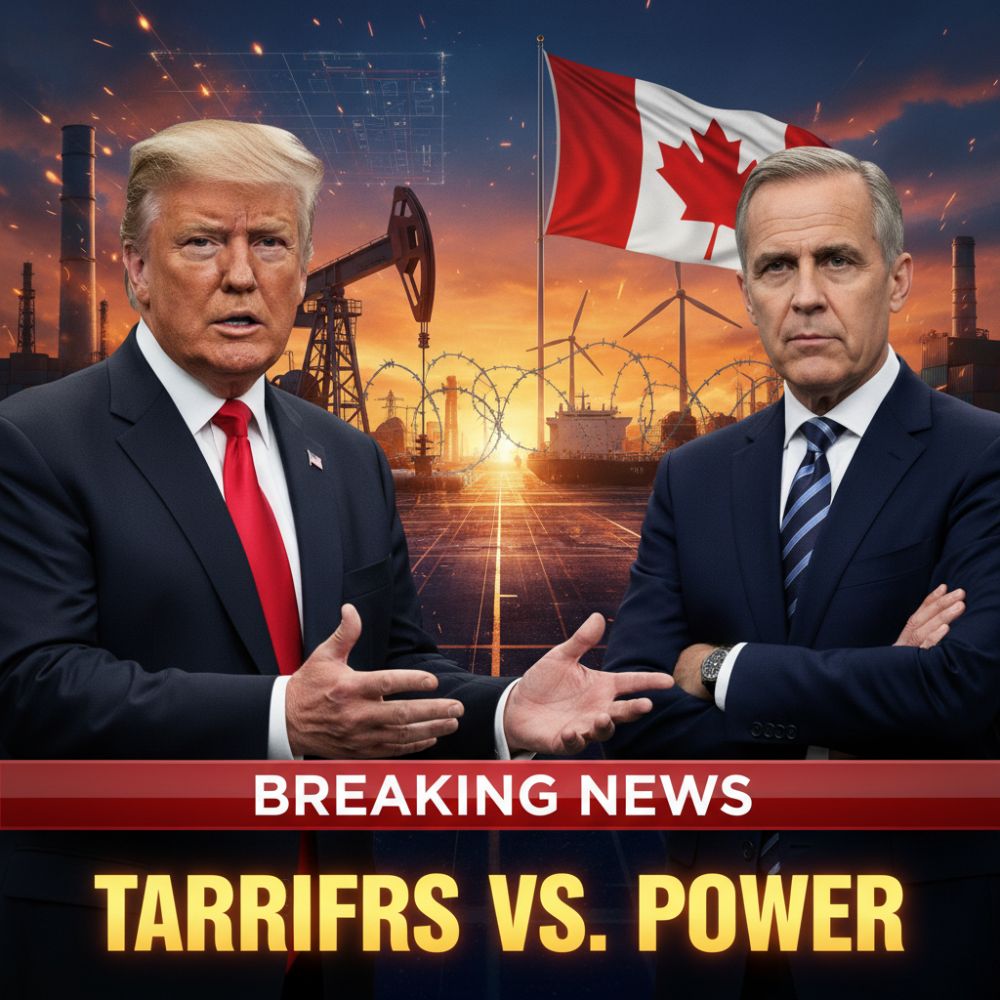
When the White House expected Donald Trump’s tariffs to force Canada into submission, Prime Minister Mark Carney chose a very different path—measured, calculated, and deeply strategic. Rather than escalating the trade war with loud retaliation, Ottawa has begun leveraging its most powerful advantage: resources. From electricity and uranium to critical minerals, Canada is quietly reshaping the trade conflict, exposing America’s deep dependencies and transforming itself from a “silent partner” into a pivotal force in North America’s energy supply chain.
When President Donald Trump launched his tariff offensive against Canada, many in Washington assumed Ottawa would eventually yield. For decades, Canada has been viewed as an economically dependent neighbor, tightly bound to U.S. markets. Under Mark Carney’s leadership, that assumption is being systematically dismantled.
Instead of responding with blunt countermeasures, Carney deployed a more refined strategy: appearing restrained on the surface while exerting pressure through resource leverage. Canada lifted tariffs on select U.S. goods to avoid uncontrolled escalation, while maintaining protective measures around strategic sectors such as steel, energy, and critical minerals. This was not weakness—it was calculated restraint.
At the center of this strategy lies energy, a vulnerability often overlooked in the U.S. economy. In 2024 alone, Canada is expected to export 35.7 terawatt-hours of electricity to the United States—enough to power roughly one million American homes. This electricity is not theoretical supply; it is real-time, grid-dependent power that cannot be easily replaced. As U.S. electricity demand surges due to data centers, artificial intelligence, and electrification, dependence on Canadian power has become increasingly visible.
Electricity, however, is not Canada’s strongest card. Uranium may be the decisive one. In 2023, Canada accounted for nearly 27% of U.S. uranium imports. With Washington cutting off Russian supply and facing escalating tensions with China, Canadian uranium has become indispensable to America’s nuclear energy sector. What began as a tariff dispute now touches the core of U.S. national energy security.
Aware of this leverage, Carney has expanded his strategy beyond North America. While maintaining a careful balance with Washington, he has reached out to European leaders, positioning Canada as a stable, democratic supplier of clean energy and critical minerals. The objective is clear: reduce U.S. leverage by expanding Canada’s strategic alternatives.
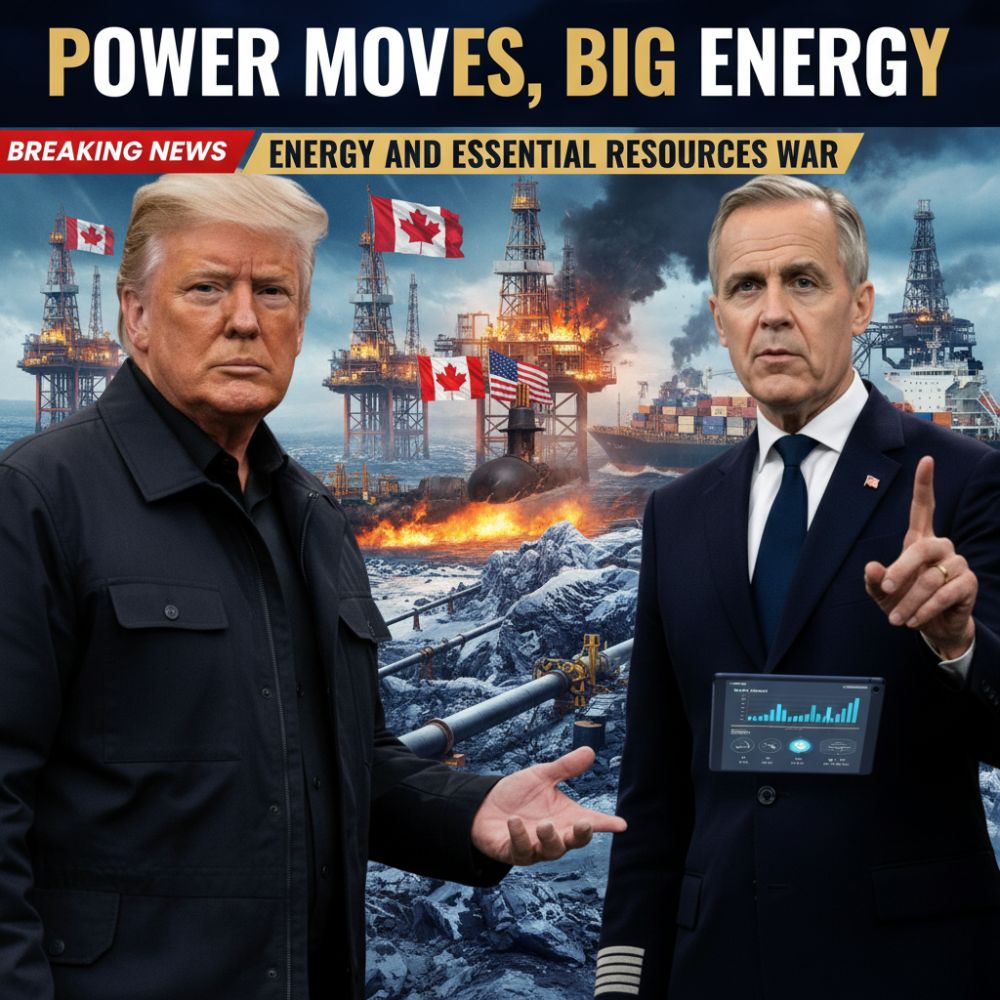 The economic consequences of the trade conflict are already emerging south of the border. U.S. utility companies have announced rate increases, and American consumers are facing higher energy bills. The paradox of Trump’s tariffs is becoming evident: policies designed to protect U.S. industry are instead driving up the cost of energy and essential inputs, exposing fragile supply chains.
Meanwhile, Canada is accelerating investment in clean energy and critical mineral development—materials essential for electric vehicles, batteries, and advanced technologies. Ottawa’s ambition is to become a global supplier capable of competing with China and Russia in sensitive supply chains. If successful, Canada will not merely defend itself against tariffs—it will climb into a higher tier of global economic influence.
Notably, Carney has avoided confrontational rhetoric. There have been no dramatic threats, no public ultimatums. Instead, he has relied on what analysts describe as “quiet power”—letting energy flows, export contracts, and hard numbers speak louder than political slogans. It is a strategy that leaves Washington with limited options, as retaliation risks self-inflicted damage.
This conflict, then, is about far more than tariffs. It represents a redefinition of Canada’s role—from a dependent trading partner to a strategic resource power with continental influence. In an era where energy and minerals define geopolitical strength, Ottawa is demonstrating that geography and natural resources can be more potent diplomatic tools than tariffs.
As the trade war continues, one reality is increasingly clear: Canada is no longer a passive participant. Under Mark Carney, the country is rewriting the rules—not through political theatrics, but through control of the resources modern economies cannot function without.
And in this contest, Washington may be the side forced to reconsider its strategy.