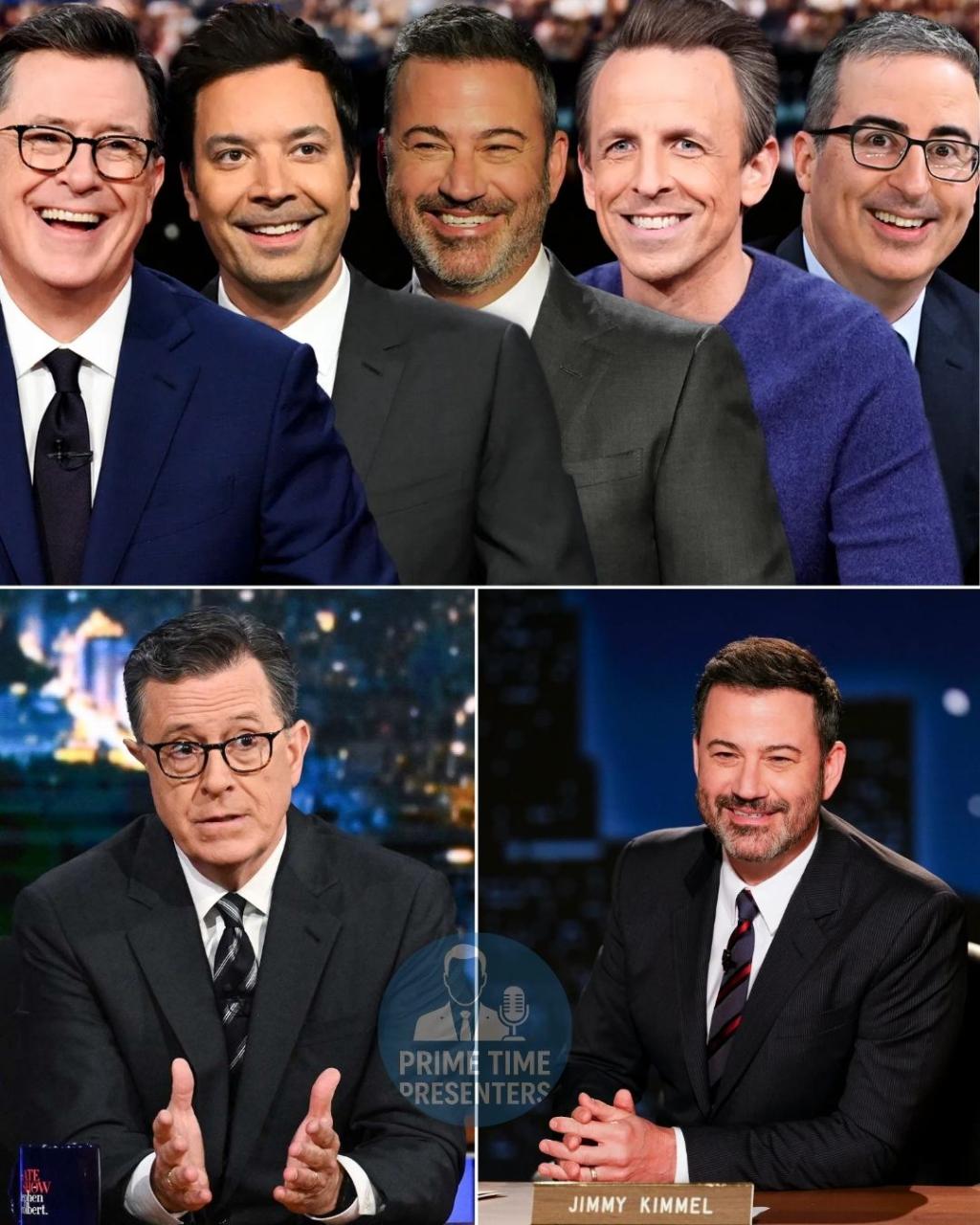
It reads like a cinematic fever dream: five of the most dominant voices in late-night—Stephen Colbert, Jimmy Fallon, Seth Meyers, John Oliver, and Jimmy Kimmel—quietly forming a cross-network alliance that could blow a hole through the old studio system.
The rumor doesn’t just claim “a collaboration.” It claims a rebuild. One unified program. One shared platform. No network walls. No safe boundaries. A single, rolling show that merges satire, interviews, field pieces, and cultural commentary into a new kind of nightly event—something closer to a comedy newsroom than a talk show.
And then the story adds gasoline: executives “scrambling,” boardrooms “panicking,” the old guard “reeling,” as if the entire industry is watching the ground shift beneath it.
Before we go any further, let’s establish the most important fact about this “five-comet collision” narrative:
There is no widely confirmed public announcement that this alliance exists.
But here’s the second, equally important fact:
Even as a rumor, it makes a terrifying amount of sense.
Because it taps into the one truth every television executive understands and every viewer feels: late-night is not just a format. It’s a habit. And habits are changing fast.
Why this rumor feels believable in a way most “TV alliance” chatter doesn’t
Most entertainment rumors collapse under the weight of logistics. Contracts, schedules, rights, and egos kill big ideas before they leave the napkin.
So why does this one feel different?
Because the premise isn’t just “five stars want attention.”
It’s “five stars are watching their entire industry mutate in real time.”
Late-night used to be built around one predictable engine: broadcast or cable, a fixed time slot, an audience trained to show up at the same hour every night. That engine is sputtering across the business—fragmented viewing, short clips, streaming-first habits, and younger audiences who don’t even think of “late-night” as a time anymore.
If you’re a late-night host today, you’re not only competing with each other. You’re competing with the entire internet.
So the rumor isn’t saying these hosts want to “win late-night.” It’s saying they want to outgrow it.
And that’s why it spreads: it sounds like a plausible survival move dressed up as a revolution.
The “recently silenced” angle: why Kimmel is the spark in the myth
Every viral saga needs a plot twist, and this one has a built-in one: Jimmy Kimmel as the “recently silenced” voice.
Whether that phrasing is fair or exaggerated, the storyline has emotional power: the idea that a big mainstream platform can disappear fast, and that the response isn’t to apologize or retreat—but to build a new stage where nobody can pull the plug.
In rumor form, Kimmel becomes the catalyst: the one who proves the old system can still tighten the leash. In that narrative, the other four don’t join because they’re bored; they join because they see the same risk coming for everyone.
That may or may not reflect reality—but it’s the kind of storyline the public instantly understands.
Because it’s not only about celebrities. It’s about power and who controls the microphone.
If this “mega-show” were real, what would it actually look like?
Let’s play it out like a producer would.
A true five-host alliance wouldn’t be “five monologues back-to-back.” That would be exhausting, expensive, and frankly unnecessary.
It would likely be a modular show—built like a modern media machine:
1) A rotating anchor desk, not five equal time slices
One night Colbert drives. Another night Fallon drives. Another night Meyers drives. Oliver hosts a weekly “long segment” within the larger show. Kimmel appears as a special correspondent style presence or host blocks.
This keeps the brand unified without turning it into a scheduling nightmare.
2) A hybrid release schedule: nightly clips + weekly tentpoles
The old model is one show per night on one channel. A new model would be:
- a shorter, fast-turnaround nightly core episode
- bigger weekly “event” episodes with longer segments and deeper reporting
- immediate clip packaging designed for modern sharing habits
If you’re trying to “shatter the power structure,” you don’t aim for one time slot. You aim for omnipresence.
3) A comedy newsroom feel
The rumor describes “raw storytelling” and “no spinning.” In practical terms, that probably means:
- fewer celebrity fluff interviews
- more on-the-ground pieces
- sharper editorial voice
- longer-form explanations
- a bigger writing/reporting staff that can turn headlines into segments fast
In other words: something that borrows from satire, news magazines, and documentary storytelling without turning into a lecture.
4) A distribution strategy that avoids one boss
If the goal is “no gatekeeper can shut us down,” the platform would likely be multi-lane:
- streaming partner (for scale)
- audio podcast feed (for daily reach)
- direct subscription layer (for stability)
- live events (for brand and revenue)
- licensing deals (for global syndication)
A true rebellion isn’t only creative. It’s financial.
Why executives would actually worry about this
The rumor paints executives “trapped in boardrooms.” That’s dramatic, sure. But the underlying fear is real.
A five-host alliance would threaten the industry in three ways:
1) It breaks the monopoly on star power
Networks survive by locking down talent. If top talent leaves the walls behind—or even just threatens to—the leverage shifts.
Suddenly, the network isn’t the platform. The host is the platform.
2) It exposes how replaceable the format has become
Late-night shows are expensive, schedule-dependent, and vulnerable to ratings dips. If a new program proves you can deliver late-night energy without the old pipeline, it makes the old machine look outdated.
And nothing scares legacy media like looking outdated.
3) It could reset the advertising map
Advertisers follow audiences. If a new show captures the “late-night mindshare” across platforms, advertisers would move budgets in a hurry.
Networks don’t just fear losing viewers. They fear losing predictable revenue.
The human reality: would these five even want to do this?
Here’s where the rumor meets real life.
These are not five people with unlimited free time. They have existing shows, writing staffs, production obligations, and personal lives built around demanding schedules.
So if an alliance were real, it would have to answer one brutal question:
What problem is big enough to justify all this effort?
And that brings us to the most interesting explanation of all.
Maybe the alliance rumor isn’t “they’re starting a show.”
Maybe it’s “they’re testing leverage.”
In industries like entertainment, the biggest changes often begin as pressure campaigns:
- quiet conversations
- exploratory meetings
- “what if we did this?”
- a rumor leak that signals seriousness
- a negotiation that suddenly tilts
Sometimes the “alliance” never becomes a show. Sometimes it becomes a negotiating weapon that reshapes contracts, creative control, and distribution rights.
The public sees “revolution.” The business side sees “leverage.”
And both can be true.
The audience-side truth the rumor reveals
Whether or not this alliance exists, the rumor is thriving because it captures a feeling people already have:
The old late-night system doesn’t feel like it’s built for this era.
Viewers are tired of:
- jokes that feel carefully padded
- interviews that feel like publicity stops
- segments that dance around obvious truths
- “safe” commentary that sounds pre-approved
They want less polish and more clarity. Less performance and more voice.
A rumor about five late-night giants joining forces is basically a fantasy that says:
“Fine. If the system can’t produce what we want anymore, maybe the artists will.”
The risk nobody in the rumor mentions: the moment you promise “no apologies,” you invite scrutiny
The rumor’s language—“unfiltered,” “no apologies,” “revolution”—is catnip for audiences. It’s also a trap.
Because once you promise “raw,” people will measure you harshly:
- Are you actually bold, or just louder?
- Are you actually honest, or just more partisan?
- Are you building something new, or just packaging outrage with better lighting?
The irony is that the more you pitch “no spin,” the more your audience will demand accountability for every line.
That’s not a reason not to do it. It’s a reason to do it well.
If this alliance happens, here’s the most likely outcome
It wouldn’t “collapse the empire overnight.”
What it would do is more subtle—and more disruptive.
It would normalize the idea that:
- top talent can build outside network walls
- audiences will follow personalities, not channels
- a show can be distributed like a media company, not a time slot
- late-night can evolve into a cross-platform daily brand
And once that idea is proven, other people will copy it.
That’s how revolutions actually happen in media: one proof-of-concept, then a flood.
The bottom line
Right now, the “five-comet alliance” reads like a high-powered rumor—electrifying, cinematic, and not publicly confirmed.
But even as a rumor, it’s doing something important: it’s revealing what audiences want late-night to become, and what the industry quietly fears it might have to become.
Because the real headline isn’t “five hosts are teaming up.”
The real headline is this:
The old late-night machine is no longer the only way to own the night. And everyone can feel it.






