A line has been crossed in the Canada–U.S. trade war, and it doesn’t run through factories or car plants. It runs straight through America’s farmland.
As tensions between Ottawa and Washington hit a boiling point, Canada is now openly signaling that potash—the single most critical input in modern agriculture—could become a pressure point.
If Canada restricts or cuts off exports, the result wouldn’t be inconvenience. It would be a historic agricultural crisis for the United States.
The numbers explain why this moment is so dangerous.
The United States imports 93% of the potash it uses, and Canada supplies between 85% and 87% of that total. In 2023, the U.S. produced just 400,000 metric tons of potash—while consuming roughly 5.3 million metric tons. That gap is not a rounding error. It’s a structural dependency.
Other suppliers barely register by comparison. Russia accounts for about 11%, Belarus 4%, and Israel 3%—all sources constrained by geopolitics, sanctions, or limited capacity. There is no backup plan. No surge capacity. No quick fix.
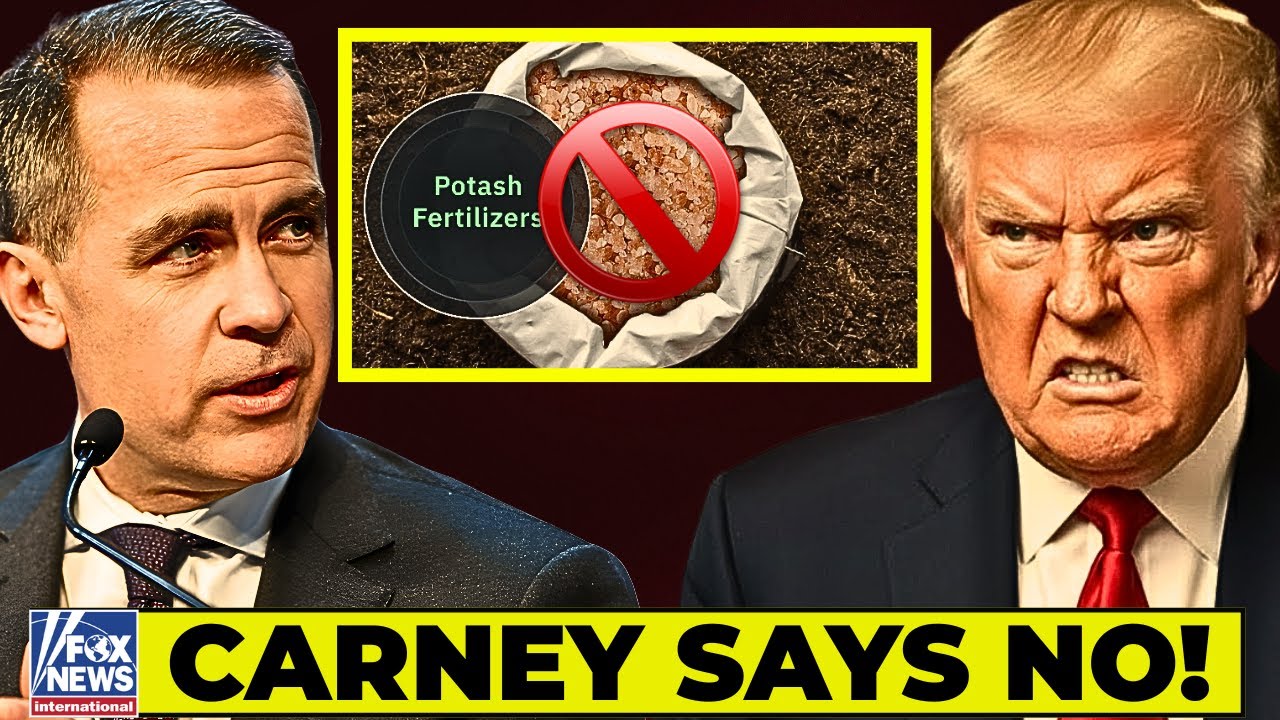
As one fertilizer executive put it bluntly: “If we start to upset Canada, where else in the world do you go?”
That’s the nightmare scenario now haunting U.S. agriculture.
Potash is not optional. It is one of the three essential nutrients—alongside nitrogen and phosphorus—required for crop growth. There is no substitute. Without it, yields collapse. And unlike machinery or fuel, potash cannot be swapped out or improvised.
Canada knows this. It holds the world’s largest potash reserves—1.1 billion tons, five times larger than U.S. reserves. Its mining scale is 36 times larger than American production, with Saskatchewan alone accounting for roughly 32% of global supply.
That makes potash more than a commodity. It makes it leverage.
For American farmers, the timing could not be worse.
Fertilizer already represents 30–45% of annual operating costs, depending on the crop. For corn alone, fertilizer accounts for up to 44% of per-acre costs. Farmers sell into global commodity markets where prices are fixed—they can’t simply pass higher costs on to consumers.

Since 2020, fertilizer costs have been brutal. In 2022, costs per acre surged 110% for corn and 141% for wheat compared to the previous decade’s average. While prices have cooled from their Russia–Ukraine peak, they remain stubbornly high—while crop prices have fallen.
The result is a squeeze that’s becoming existential.
The U.S. Prices Paid Index for farmers hit 149.9 in June 2025, up sharply year over year, with fertilizer as the single biggest driver. Farmers now need to produce more bushels just to afford the same inputs. Profit margins are evaporating.
And without Canadian potash, things spiral fast.
The massive 2025 harvest depleted soil nutrients across the Midwest.
Those nutrients must be replaced this fall and next spring—or 2026 yields will collapse. U.S. potash mines in New Mexico, Utah, North Dakota, Arizona, and Michigan cannot scale fast enough. Developing new mines takes years, not months, and some U.S. deposits are lower quality.
Washington knows this. That’s why Trump announced a $12 billion farm aid package—a preemptive cushion for trade damage. But even administration officials quietly admit the money won’t fix the core problem.

You can subsidize losses. You cannot subsidize fertilizer that doesn’t exist.
Industry groups are already sounding alarms. The American Farm Bureau says farmers have suffered losses on major crops for three consecutive years. Net farm income is projected to fall sharply—by as much as $30 billion more if fertilizer access is disrupted.
Even Republican lawmakers are uneasy. Senator Chuck Grassley has pushed to exempt potash from tariffs entirely, calling it indispensable. In November 2025, the U.S. itself classified potash as a critical mineral—acknowledging it as strategically essential to national security.
And yet, Canada—the primary source of that critical mineral—is simultaneously facing tariff threats and political pressure from Washington.
That contradiction is now blowing up in real time.
Experts warn that using potash as leverage would be the “nuclear option” in trade relations.
Consumers wouldn’t feel the impact immediately—but when higher fertilizer costs ripple through the supply chain, grocery prices would rise. Food inflation would follow. And once yields fall, recovery could take years.
This is no longer a theoretical trade dispute.
What began as tariffs and rhetoric has escalated into a confrontation over food security. Trump’s pressure campaign was meant to protect American interests. Instead, it has exposed a vulnerability so severe that even hinting at disruption sends shockwaves through U.S. agriculture.
Canada didn’t create that dependency.
But now, it controls it.
And American farmers are staring at the consequences of a trade war that just crossed into dangerous territory.