January 2026. To casual observers, Canada looks like a country doing what countries always do: upgrading its military. A competition for 12 advanced submarines, a program reportedly valued at over $100 billion across a 50-year service horizon. Simple story, right?
Wrong.
Because if this were only about submarines, one detail makes no sense: why was the executive chair of Hyundai Motor Group—an auto empire built on EVs and family vehicles—present in Ottawa during high-level negotiations?
Not a defense minister. Not a navy admiral. Corporate royalty from Korea’s biggest industrial machine.
That’s when the real story snaps into focus.
Canada wasn’t shopping. Canada was setting terms.
By late December 2025, the field for the Canadian Patrol Submarine Project had narrowed to two global heavyweights: Germany’s Thyssenkrupp Marine Systems and South Korea’s Hanwha Ocean—both offering cutting-edge diesel-electric submarines capable of patrolling Canada’s three-ocean footprint.
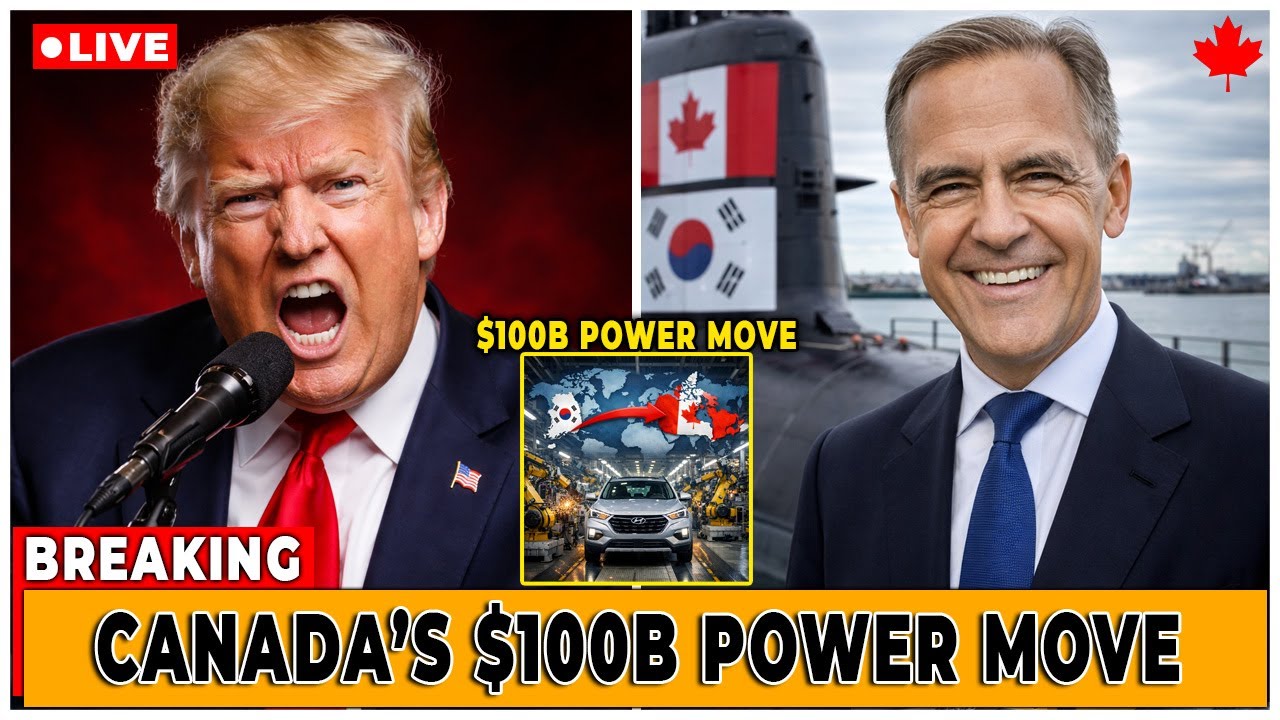
Defense insiders assumed it would follow the old script: stealth metrics, sonar, endurance, NATO compatibility, price per hull. Germany’s Type 212 CD—backed by a proven partnership with Norway—was seen as the safe bet, the “Mercedes of submarines.”
But Ottawa wasn’t looking for the best boat.
Ottawa was looking for the best deal for Canada’s future economy.
Here’s the tell that should’ve set off alarms: the most consequential meetings didn’t just happen inside the Department of National Defence. They reportedly happened at the Ministry of Innovation.
That alone signals the pivot—this wasn’t a weapons purchase. It was industrial strategy disguised as procurement.
Canada asked both bidders a question you won’t find in any naval manual:
“What are you going to build in Canada besides submarines?”
In one sentence, Ottawa changed the rules of the game.
Instead of “How quiet is your engine?” it became: “How big is your commitment?” Canada wanted more than hulls and maintenance contracts. It wanted EV factories, battery supply chains, green hydrogen, steel production, AI labs, and long-term industrial rebuilding tied to defense spending.
Germany, by this account, looked caught off guard—prepared for torque curves and pressure hull specs, not civilian battery ecosystems. South Korea reportedly understood instantly: the submarine wasn’t the product. It was the entry ticket.
Then came the moment that lit up the entire story.
On January 21, 2026, a high-ranking Korean delegation allegedly arrived in Ottawa with the intensity of a state visit: top government officials—plus Euisun Chung, Hyundai Motor Group’s executive chair. In a submarine negotiation.
That’s not a normal sales pitch. That’s a message:
“We’re not here to sell hardware. We’re here to integrate economies.”
And when the memorandum of understanding was signed, it reportedly went far beyond submarine parts.
The commitments described read like a Canadian economic revival playbook: expanded Korean automotive presence, a widened battery value chain from minerals to refining to manufacturing, hydrogen-powered commercial trucks, AI cooperation, cement, nuclear technology, LNG—and crucially, steel.
One of the sharpest moves: Hanwha’s plan to source steel from Algoma Steel for the submarine fleet—meaning a large portion of each submarine dollar cycles back into Canadian industry and workers if the bid succeeds.
Connect the dots and the strategy becomes almost unsettling in its clarity: Canada allegedly turned a defense program into a gatekeeping mechanism for North American market access—charging an “admission fee” in the form of factories, jobs, and long-term capability.
And here’s the twist that makes this story feel bigger than economics: the transcript argues South Korea’s eagerness isn’t just about profit—it’s about risk.

South Korea’s industrial core sits on a vulnerable peninsula, with major production capacity within reach of regional instability. The idea of “offshore redundancy”—a secure industrial backup in a stable democracy—becomes more than business strategy.
Canada offers distance, rule of law, and critical minerals. In that framing, Canada stops being just a customer and becomes something closer to an insurance policy.
Meanwhile, Canada’s timing is brutal. Southern Ontario’s manufacturing base has been bleeding, traditional auto giants cutting production, job anxiety rising.
And now, instead of a single project, Canada is positioned to receive an integrated industrial package spanning defense and civilian supply chains.
Defense analysts have a name for this style of bargaining: strategic reciprocity—where access to defense spending requires real domestic economic reconstruction, not vague offsets.
If this is accurate, the submarine contest isn’t really about submarines anymore. It’s about who is willing to weave their industrial future into Canada’s most completely—and who understands that sovereignty is not just weapons you can buy, but factories you can build.
And if South Korea is truly ready to pour up to $100 billion worth of long-horizon economic alignment into Canada for the prestige and security of that partnership, then one conclusion becomes hard to ignore:
Trump didn’t just lose a contract.
He may have lost leverage—because Canada is learning how to turn pressure into a magnet for alternatives.