Donald Trump thought he had found Canada’s pressure point.
Aircraft.
Late at night, in a familiar burst of online bravado, the U.S. president threatened to decertify all Canadian-made aircraft operating in the United States and slap a 50% tariff on planes built north of the border.
He named Bombardier directly, accusing Canada of blocking certification for American-made Gulfstream jets while enjoying free access to the U.S. market.
On paper, it sounded devastating. In reality, it backfired—fast.
Within hours, panic rippled through aviation markets. Aerospace is not steel or lumber. It’s one of the most tightly regulated industries on Earth, governed by safety frameworks deliberately designed to stay out of politics.
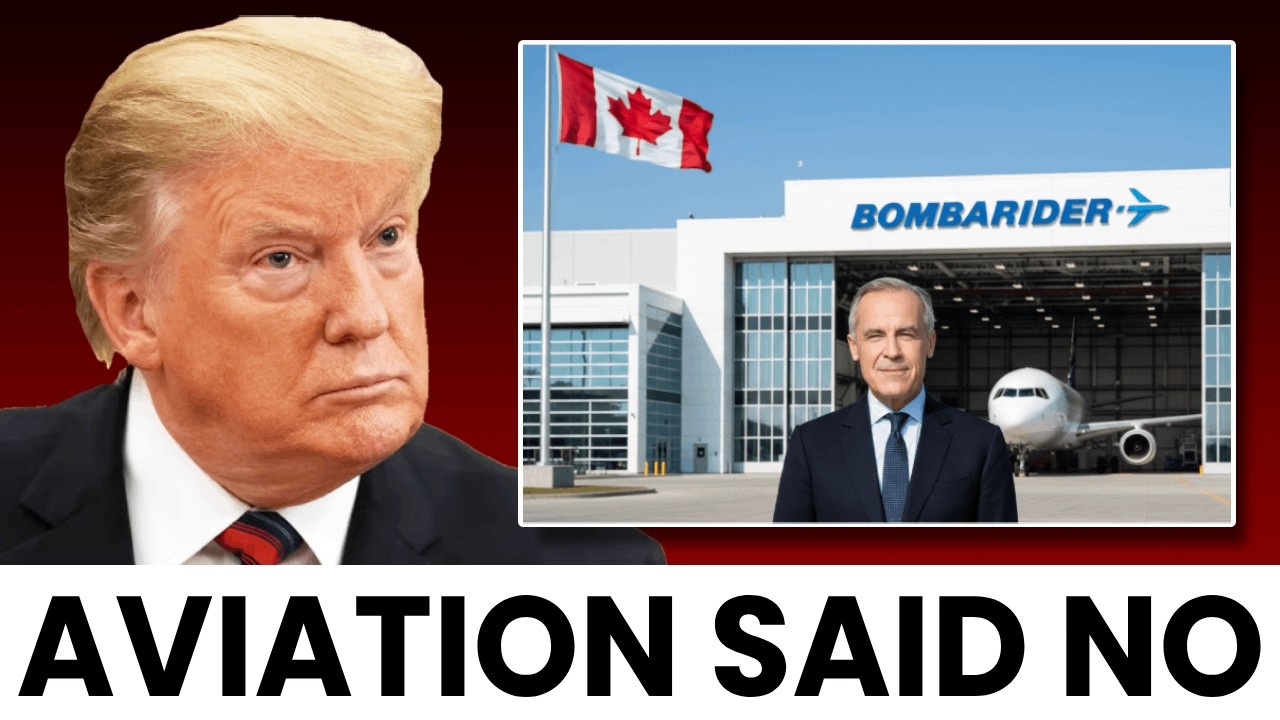
Trump’s threat didn’t just target Canada—it challenged the foundation of global aviation trust.
And that’s where the plan collapsed.
Canada is not a minor player in aerospace. More than 5,500 Canadian-manufactured aircraft are registered to operate in the United States, including roughly 150 Bombardier Global Express jets used by over a hundred American companies.
Regional airlines across the U.S. depend on Canadian-built aircraft for short-haul routes. Any sudden disruption wouldn’t “hurt Canada.” It would paralyze American aviation.
Almost immediately, damage control began. White House officials clarified that existing Canadian aircraft would not be grounded. FAA officials quietly echoed the same message to airline executives. The threat, it became clear, ran headfirst into legal and regulatory walls.
Here’s the uncomfortable truth Trump ran into:
The president cannot decertify aircraft for political reasons.

Under U.S. law, the FAA can revoke certification only for safety concerns, not trade retaliation. There is no legal mechanism to ground thousands of aircraft to score leverage in a tariff dispute.
Aviation analysts warned that attempting to do so would trigger lawsuits, international retaliation, and chaos across global air travel.
The irony? Bombardier’s U.S. footprint makes the threat self-defeating. The company employs thousands of American workers, operates service centers across multiple states, and runs a growing defense operation in Kansas.
A real escalation wouldn’t just hit Montreal—it would hit American jobs, unions, and supply chains.
Labor groups saw the danger immediately. The International Association of Machinists and Aerospace Workers warned that politicizing aerospace trade puts thousands of North American jobs at risk.
Even hinting at disruption is enough to freeze orders, delay investment, and spook airlines planning fleet expansions years in advance.
At the center of Trump’s complaint sits a technical issue most politicians never touch: certification timelines. Gulfstream’s newest jets—the G500, G600, G700, and G800—have cleared the FAA and European regulators. Transport Canada, however, has not finished its own validation process.

That delay is not unusual. Certification routinely involves additional testing, documentation, and cold-weather performance reviews. In fact, the FAA’s approval for some Gulfstream models includes temporary exemptions related to fuel-icing rules, with deadlines still months away.
Conditional approvals like this are common—and exist precisely to avoid rushing aircraft into service before all safety questions are resolved.
Aviation experts point to recent history as a warning. The Boeing 737 Max disasters, which killed 346 people, remain a raw reminder of what happens when certification rigor is compromised.
More recently, a 737 Max door plug failure in 2024 reignited scrutiny of manufacturing oversight. Against that backdrop, threatening regulators over safety decisions looks reckless, not strong.
Context matters. Just days earlier, Canadian Prime Minister Mark Carney warned that the U.S.-led global trade system was weakening and urged countries to diversify rather than rely on economic coercion.
Trump’s response—public threats, tariff talk, and now aerospace pressure—signaled how personal the dispute had become.
But the outcome was not dominance. It was exposure.
The episode revealed how insulated aviation actually is from presidential muscle-flexing—and how deeply integrated Canada and the U.S. remain despite political theatrics.
Analysts say there’s no evidence Gulfstream sales in Canada have suffered at all. Buyers can legally register aircraft in the U.S. while awaiting Canadian certification, a standard industry workaround.

In the end, Trump didn’t lock Canada out of the U.S. market.
He reminded everyone why he can’t.
Bombardier kept flying. U.S. airlines kept operating. Regulators kept their independence. And what was meant to look like a crushing blow instead highlighted a hard limit on political power—one written into law, safety rules, and mutual dependence.
The message from the cockpit was unmistakable:
Trade wars may rage on social media, but aviation doesn’t take orders from tweets.






