Let us be absolutely clear from the outset. What the world is witnessing today is not a routine trade dispute, not a temporary standoff driven by tariffs or political theatrics. What is unfolding is far more consequential: the slow but unmistakable collapse of a global trade order that Washington long assumed it would dominate indefinitely.
China did not hesitate. It did not blink. It pivoted.
And what Beijing is offering Canada at this moment is not merely an expansion of trade volumes. It is a fundamental realignment of economic gravity across the Western Hemisphere.
The Miscalculation That Changed Everything
For months, tensions across the Pacific escalated as the United States attempted to reassert control over global trade through tariff threats and economic pressure. The strategy relied on a familiar assumption: that fear would produce compliance.
Instead, Beijing responded with something Washington no longer seems to understand—patience.
Western analysts confidently predicted China would buckle under pressure. They warned that its export-driven economy would collapse, that Beijing would return to the negotiating table desperate for relief. Every one of those predictions proved catastrophically wrong.
On November 2, 2025, China’s ambassador to Canada stood before international media in Beijing and posed a deceptively simple question:
“If two countries already trade competitively, why shouldn’t we triple that trade?”
In plain geopolitical language, the message was unmistakable. The era of unquestioned American economic dominance is ending.
China’s Strategy: Quiet, Calculated, Effective
Unlike Washington’s approach, Beijing did not issue threats or perform outrage on social media. It simply redirected supply chains.
Shipping containers that once sailed toward Los Angeles were rerouted to Rotterdam, Singapore, and Vancouver. Trade did not stop. It moved.
The data tells the story clearly. Chinese exports to the United States fell sharply. Meanwhile, exports to the European Union rose, shipments across Asia surged, and new partnerships solidified at speed. This was not chance or market noise. It was deliberate disengagement.
China demonstrated a principle Washington appears to have forgotten: strategy outlasts bravado.
How Canada Became the Center of Gravity
Almost unintentionally, Canada has emerged as the most strategically valuable trade partner in North America.
The turning point came with the completion of the Trans Mountain pipeline in 2024, capable of transporting up to 850,000 barrels of oil per day. Almost immediately, China became its largest customer.
For years, China imported virtually no Canadian oil. That changed overnight. As Canadian exports to China climbed steadily, American purchases declined. This was not coincidence or convenience. It was economic signaling.
The message to Washington was clear: if you choose confrontation, China will choose alternatives.
Washington’s Tariff War and Its Consequences
To understand how this moment emerged, one must return to early 2025. Upon returning to the Oval Office, Donald Trump escalated tariffs on Chinese goods to unprecedented levels, at times exceeding 100%. In Washington, the expectation was panic.
Instead, Beijing responded with silence.
Supply chains were rerouted. Contracts were rewritten. And when China made clear it could restrict access to critical minerals essential to American manufacturing, tariffs were quietly reduced and rebranded as a “victory.”
This was not negotiation. It was economic self-inflicted damage, disguised as strength.
By late 2025, U.S. national debt surged at an alarming pace, with trillions added in mere months. Allies were pressured, insulted, and treated as revenue sources rather than partners. The result was predictable: they began to exit.
Why China’s Offer Matters So Much
China’s proposal to triple trade with Canada is not symbolic. China’s economy is roughly ten times larger than Canada’s and remains the world’s manufacturing engine. When a system of that scale offers structural partnership, it signals a long-term shift, not a temporary deal.
The timing is critical. As Washington openly undermines Canadian industries—questioning its automotive sector, agricultural exports, and even joking about annexation—Beijing is extending a markedly different approach.
Respect. Reciprocity. Scale.
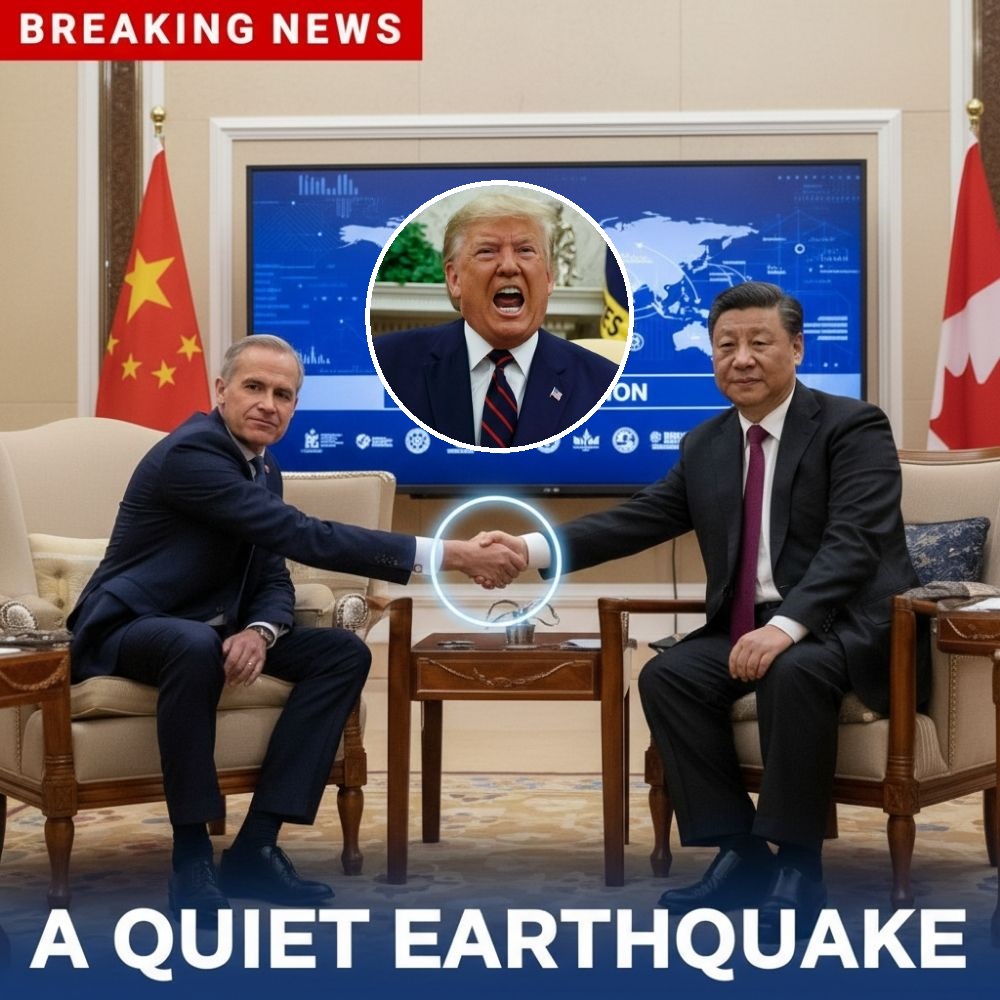
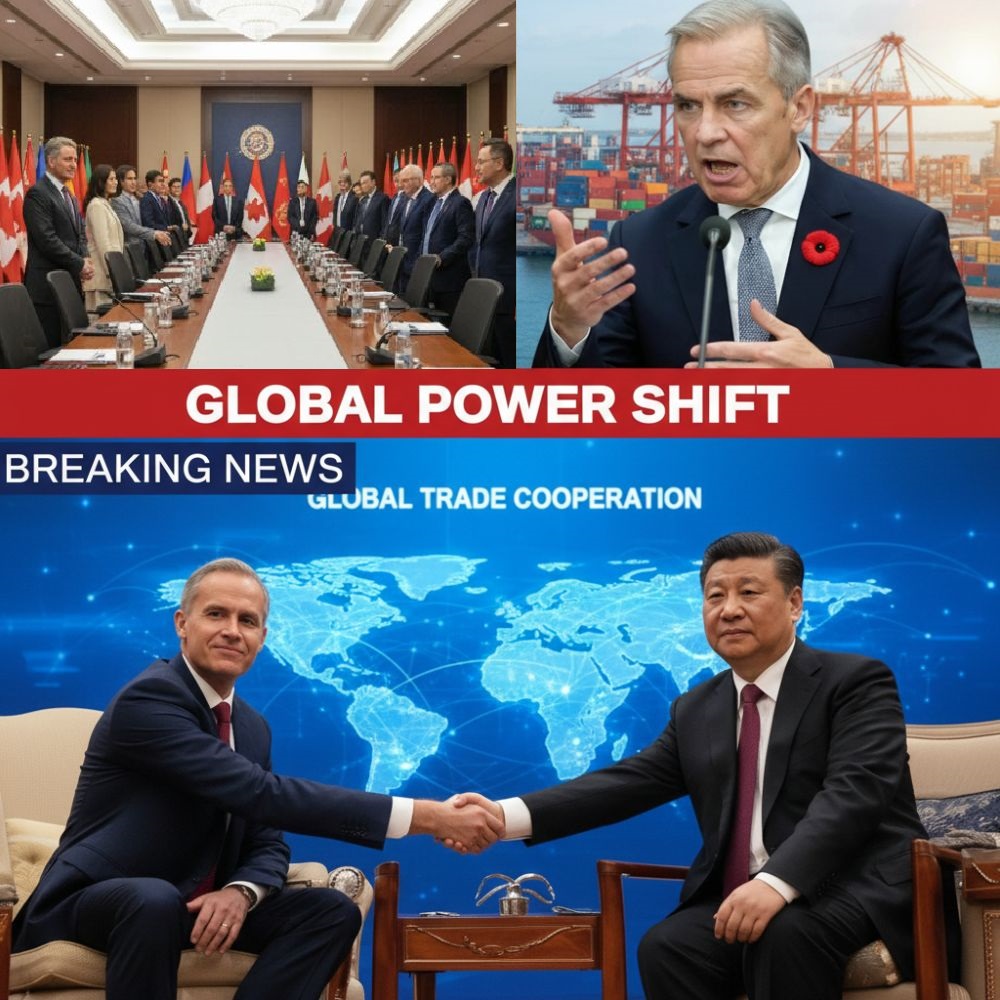
Prime Minister Mark Carney’s meetings with Chinese leadership at recent Asia-Pacific summits reinforced that Ottawa is open to recalibrating relationships. Diplomatic language about “addressing irritants” translates simply: Canada is exploring options.
China’s response was firm but polite: why double trade when tripling is possible?
The Complications—and the Opportunity
This potential realignment is not without complexity. Canada’s auto industry remains deeply integrated with the United States. Opening markets to Chinese electric vehicles requires careful negotiation.
But complexity is not a reason for paralysis.
Strategic options exist: joint manufacturing on Canadian soil, battery supply chains using Canadian lithium and nickel, or controlled market access tied to domestic job creation. This is not ideology. It is industrial strategy.
Handled correctly, Canada could emerge more autonomous, diversified, and resilient.
A Stark Contrast in Leadership Styles
The contrast between the two approaches could not be clearer.
On one side, Washington engages in spectacle—threats, insults, tariff swings, and escalating debt. On the other, Beijing says little publicly, redirects capital quietly, and signs contracts methodically.
One strategy relies on noise. The other relies on planning.
The outcomes speak for themselves. Chinese exports to the U.S. decline. Exports elsewhere accelerate. Canada receives offers that would have been unthinkable five years ago.
A Defining Choice for Canada—and Others
Canada now faces a pivotal decision. Maintain reflexive loyalty to an ally that treats economic independence as disobedience—or pursue diversified partnerships that reduce vulnerability to coercion.
This decision extends beyond Ottawa. Other U.S. allies are watching closely. Australia. Japan. South Korea. If Canada demonstrates that rebalancing is possible, others will follow.
This moment does not require confrontation or ideology. It requires discipline, professionalism, and long-term vision.
China understands this. That is why the offer is being made now.
Conclusion: A Door Is Open
The global trade order is not merely shifting. It is being rebuilt. And the United States is increasingly finding itself outside the room—not out of hostility, but because unpredictability is incompatible with complex economic systems.
China has opened a door for Canada. It is already buying Canadian oil. It is ready to negotiate broader integration.
The offer is real.
The question is no longer whether the opportunity exists, but whether Canada has the confidence to seize it.
If not Canada, who?
If not now, when?