For years, the Saab Gripen carried a label that stuck stubbornly to its wings: overrated. Too small. Too light. Too defensive. A jet supposedly built to patrol borders, not dominate skies filled with elite NATO fighters.
Then came the rude awakening.
As Canada reconsiders its multibillion-dollar F-35 deal, the Gripen is no longer the polite afterthought in the room. It’s the aircraft that many NATO pilots quietly learned not to underestimate — sometimes the hard way.
The dismissal of the Gripen always sounded logical on paper. A single-engine fighter facing twin-engine heavyweights. Less fuel, smaller payload, fewer dramatic headlines. Compared to legends like the F-15 Eagle, the battle-tested F-16 Fighting Falcon, or Europe’s flagship Eurofighter Typhoon, Sweden’s jet looked modest.
Context shaped perception. Sweden was neutral for centuries. No major wars. No combat footage. No alliance pushing the aircraft into the spotlight. Analysts concluded the Gripen was designed for deterrence, not dominance.
That assumption collapsed in 2006 at Red Flag Alaska.

Red Flag isn’t an airshow. It’s one of the U.S. Air Force’s most demanding combat exercises, built to expose weaknesses, not flatter reputations. Pilots face electronic warfare, degraded support, limited intelligence, and relentless pressure. Survivability matters more than bravado.
When Sweden’s Gripens were assigned to the opposing “red team,” expectations were low. The opposition included U.S. F-16 Block 50s, Eurofighter Typhoons, and F-15C Eagles. Support assets were limited. Early warning coverage was constrained.
What followed stunned everyone paying attention.
According to Swedish reporting, Gripens scored 10 air-to-air kills on the first day without a single loss. One engagement reportedly saw a single Gripen pilot down five F-16s alone. While the U.S. Air Force never publicly confirmed the exact tally, the results were serious enough that the Gripen was invited back.
The secret wasn’t brute force. It was networked awareness.
Instead of relying on constant radar emissions that give away position, Gripen formations used data-link tactics. One aircraft briefly activated its radar, gathered situational data, then instantly shared it with the group. The others stayed electronically silent, effectively invisible, while still seeing the entire battlespace.
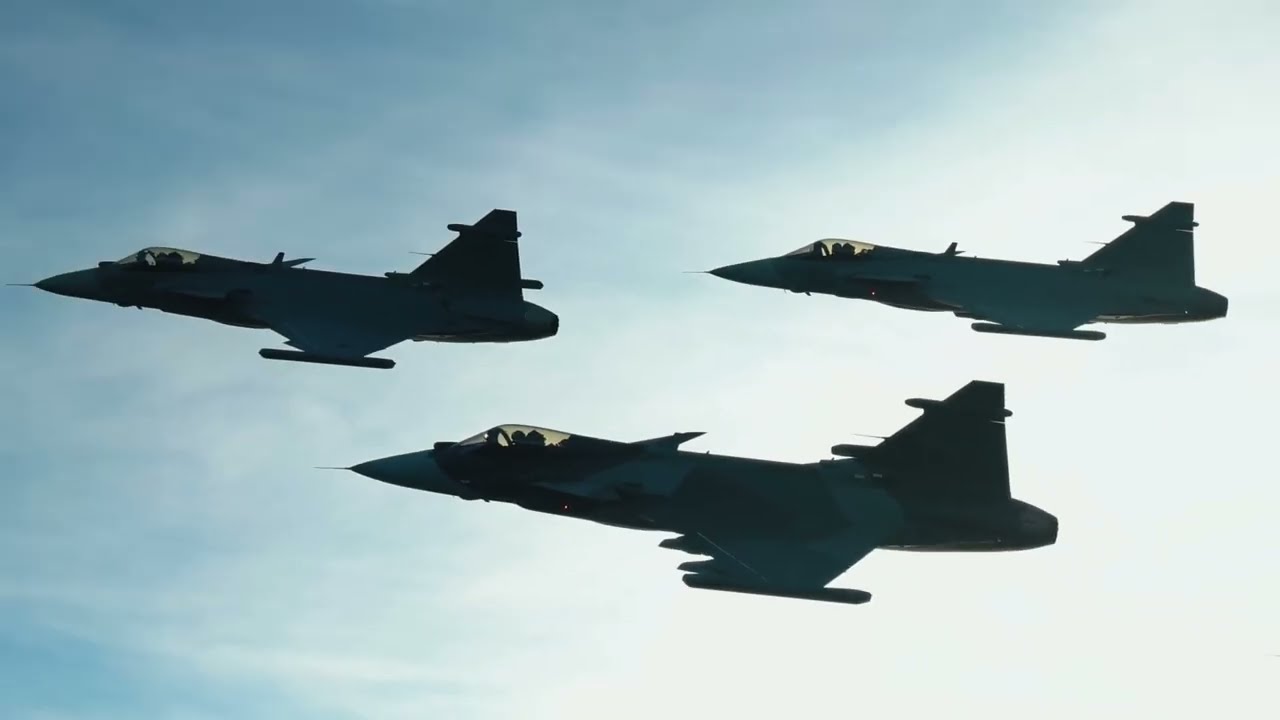
Situational awareness became shared, fluid, and deadly.
Skeptics argued the numbers came from Swedish sources. Fair enough — until Norway confirmed similar outcomes. In separate engagements, three Swedish Gripens faced five Norwegian F-16s flown by NATO-standard pilots. The results again favored the Gripen, finishing 5–1 in the final round.
This wasn’t marketing. It was peer acknowledgment.
Then reality replaced simulation.
In March 2024, Sweden officially joined NATO after more than two centuries of neutrality. Within 24 hours, Gripens were flying real missions under NATO command. Swedish Gripens, alongside Belgian F-16s and German Eurofighters, intercepted Russian aircraft over the Baltic — seamlessly, without a prolonged integration period.
In 2025, Gripens deployed to Poland as part of NATO’s enhanced air policing mission, conducting real intercepts of Russian aircraft under real geopolitical tension. No exercises. No disclaimers.
Just performance.
This record landed squarely in Canada’s lap as Ottawa reopened its F-35 contract review amid escalating trade tensions with the United States under President Donald Trump. Tariff threats and political pressure reframed the debate from pure capability to sovereignty and control.
Saab’s proposal offered something rare: full domestic assembly, full technology transfer, and access to source code. Canada would control upgrades, modifications, and integration — no external approval required. The deal projected 12,600 jobs, including 9,000 tied directly to Gripen production, with Bombardier as a central partner.
Operating costs sharpened the contrast. Depending on accounting methods, Gripen E operating costs remain significantly lower than the F-35, whose per-hour estimates often exceed $40,000. Over decades, that difference compounds into billions.
Pressure followed. U.S. officials warned that walking away from the F-35 could strain NORAD cooperation. The message was clear: this wasn’t just about jets.
But the myth of the “overrated Gripen” was already broken.
What NATO pilots learned — quietly, sometimes uncomfortably — is that modern air combat isn’t only about size, stealth, or price tags. It’s about information, flexibility, and survivability.
And the aircraft once dismissed as a budget compromise proved it could punch far above its weight.