For months, a quiet plan was taking shape behind closed doors in Washington. Donald Trump’s administration believed it had found the perfect pressure point inside Canada: Alberta. Oil-rich, politically conservative, angry at Ottawa, and heavily dependent on the U.S. market. To Trump’s team, it looked like a province ready to be peeled away.
According to reporting first revealed by the Financial Times, senior U.S. officials secretly met at least three times with leaders of the Alberta Prosperity Project, a far-right separatist group pushing for an independence referendum.
The pitch was breathtaking in scale: a proposed $500 billion U.S. Treasury credit line to bankroll an independent Alberta—step one toward eventual American statehood.
Trump’s Treasury Secretary openly called Alberta a “natural partner” for the United States. State Department officials reportedly discussed sovereignty, resources, and transition financing. The message was clear: Washington was willing to pay, handsomely, to fracture Canada and secure Alberta’s oil without absorbing the entire country.
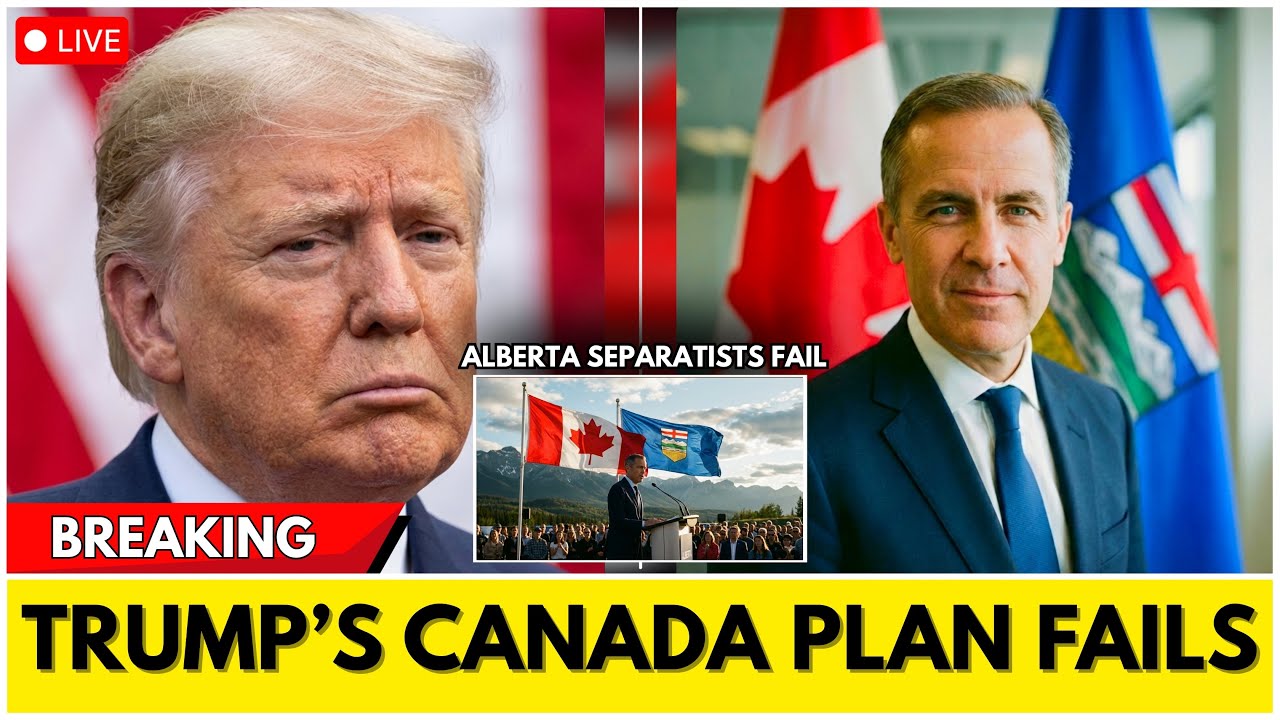
For a moment, it looked dangerous. Separatist rallies drew crowds. “Make Alberta Great Again” hats appeared. American flags waved at events. The group needed 177,000 signatures to force a referendum—and anger at the federal government made that target seem reachable.
Then Mark Carney moved.
Instead of escalating rhetorically or publicly confronting Trump, Carney executed a precision strike. He gave Alberta exactly what it had been demanding for years—inside Canada.
Emissions caps on oil and gas were suspended. Clean electricity regulations were paused. Carbon capture projects were fast-tracked. Most critically, Carney struck a deal with Alberta Premier Danielle Smith to unlock pipeline expansion toward the Pacific, opening Asian markets to Alberta oil.
The shift was seismic.
For decades, 93% of Canadian oil exports flowed to the United States, leaving Alberta vulnerable to American politics, tariffs, and threats. A Pacific export route meant access to Japan, South Korea, India, and other fast-growing energy markets—worth trillions over decades, not a one-time $500 billion promise tied to political risk.
Suddenly, Trump’s offer looked small. And unnecessary.
What Alberta wanted wasn’t separation. It wanted respect, market access, and economic security. Carney delivered all three.
The political impact was immediate. Carney—a Liberal prime minister—received standing ovations at the Calgary Chamber of Commerce, a near-unthinkable moment in modern Alberta politics. Premier Smith declared the agreement “the end of the dark times,” signaling that Alberta could thrive within Confederation.
Then came the knockout blow.
A pro-unity campaign called Alberta Forever Canada, led by former provincial cabinet minister Thomas Lukaszuk, launched a counter-petition asking a blunt question: Should Alberta remain in Canada?
The result shocked even seasoned observers.
By October, 456,000 Albertans—more than double the required threshold—had signed on. Urban and rural. Young and old. Conservatives and liberals. Calgary, Edmonton, Red Deer, Grande Prairie. The message was unmistakable: Alberta wasn’t leaving.
At the same time, the separatist petition stalled below 178,000 signatures. Polling showed only 19–20% support for independence. The loud movement turned out to be small. Symbolic anger at Ottawa had been mistaken for a desire to abandon Canada entirely.
Trump’s strategy collapsed under its own miscalculation.
By meeting with separatists and floating massive financial incentives, the U.S. administration triggered a nationalist backlash. British Columbia’s premier called the outreach “treason.” Other premiers closed ranks. Even Alberta’s pro-Trump premier drew a red line against American interference.
Trump believed money could buy a province. Carney proved legitimacy beats leverage.
By November 27, when Carney and Smith signed their agreement in Calgary, the dream of a 51st-state Alberta was effectively dead. It died again when 456,000 signatures were tallied. And again every time polls showed overwhelming opposition to separation.
In the end, Alberta didn’t choose American cash. It chose Canadian control, global markets, and long-term stability.
Trump tried to take Alberta.
Mark Carney didn’t fight him—he outplayed him.