When Donald Trump declared that Canada had “taken advantage” of the United States and should be treated like the “51st state,” many expected Ottawa to panic or back down. Instead, the threat detonated inside the United States itself — unleashing economic blowback so severe that governors, investors, and even senior Washington officials began sounding alarms.

At first, the White House wanted a confrontation. U.S. Trade Representative Jameson Greer even floated the nuclear option: Washington may withdraw from the USMCA in 2026. It wasn’t a rumor — it was a direct, deliberate threat. Within hours, markets rattled, governors erupted, and foreign investors quietly started asking: Has the United States become too risky to trust?
Then came Trump’s second provocation — mocking Canada as if Ottawa were a dependent province, not a sovereign nation. Diplomats froze. Economists braced. Investors held their breath.
Instead of Canada breaking, Washington’s own strategy cracked first.
Negotiations collapsed after the U.S. ambassador criticized Canada’s political advertising laws, accusing Ottawa of influencing American politics. Canada pushed back immediately — and that’s when the standoff shifted into something no one saw coming.

🇨🇦 Canada didn’t retreat. It transformed.
Behind the scenes, Ottawa launched a counterstrategy so methodical it stunned analysts.
By December 2025, the IMF released numbers that flipped the narrative:
Canada wasn’t collapsing under tariff pressure — it was accelerating.
Foreign direct investment surged by $77.8 billion, pushing Canada’s FDI stock to nearly $1.5 trillion, even surpassing U.S. expectations.
Canadian companies restructured supply chains into two systems: one tailored for U.S. markets, another dedicated to Europe, India, and South America.
Entire provinces pivoted seamlessly. Newfoundland and Labrador now send over half their oil production to Europe, compared to less than 10% two decades ago.
Washington had tried to squeeze Canada.
Instead, it pushed Canada into becoming more diverse, more resilient, and far less dependent.
🇺🇸 Meanwhile, the United States buckled under its own pressure.

By November 2025, several warning signs were flashing red:
U.S. manufacturing contracted nine straight months, the worst decline since 2008.
The transportation equipment sector began cutting jobs and relocating operations overseas.
Consumer spending weakened sharply — Cyber Monday sales grew only 2.6%, signaling shrinking household confidence.
Even Costco sued the U.S. government over tariffs, potentially forcing billions in refunds.
Global investors began moving capital out of the U.S. and into safer markets — Canada foremost among them. Ottawa suddenly ranked as the second-highest FDI-to-GDP destination in the G20.
For multinational companies from Japan, South Korea, and Europe, the logic became unavoidable:
“If you want to be in North America without being exposed to Washington’s volatility… move to Canada.”
🌍 The world followed Canada’s lead.
Ottawa expanded trade relationships with the EU, India, and Asian markets. Companies began using Canada as a gateway to Western markets without passing through Washington’s tariff minefield.
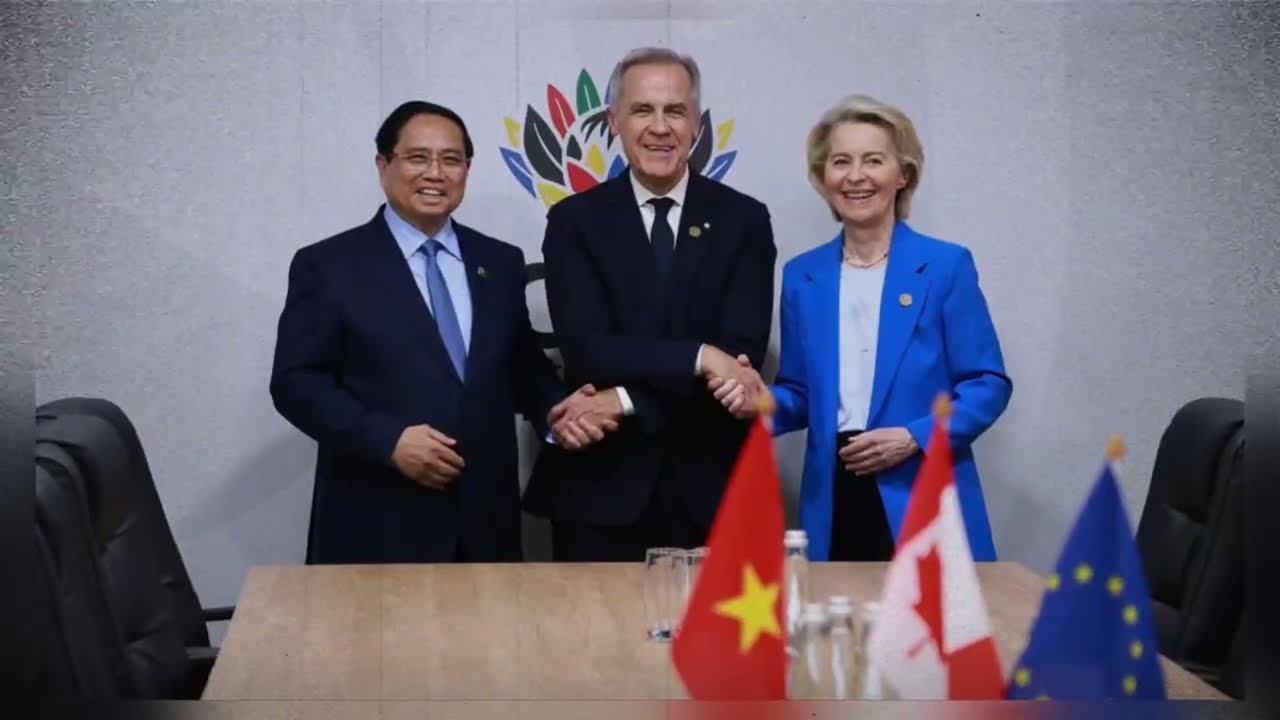
In high-tech fields — EVs, clean energy, strategic minerals — Canada surged ahead. Even reshoring trends gained momentum as Canadian manufacturers reduced dependence on U.S. components entirely.
And all the while, Ottawa remained calm, strategic, restrained — the opposite of Washington’s escalating threats.
🔥 The paradox is now impossible to ignore.
The United States attempted to pressure Canada into submission.
Instead, it may have forged a stronger competitor right across its northern border.
Canada is now:
attracting global investment,
reshaping its supply chains,
strengthening sovereignty over strategic industries,
and stepping into the 2026 USMCA renegotiations with unprecedented leverage.
Meanwhile, U.S. states are fracturing politically, governors are seeking Canada’s help directly, and global companies are quietly treating Washington as a risk factor to avoid.
The question analysts are now asking isn’t whether Canada can withstand U.S. pressure.
It’s this:
Has Washington unintentionally created the strongest economic rival it’s ever had — sitting right on its own border?
Because the more the U.S. threatens, the stronger Canada seems to become.