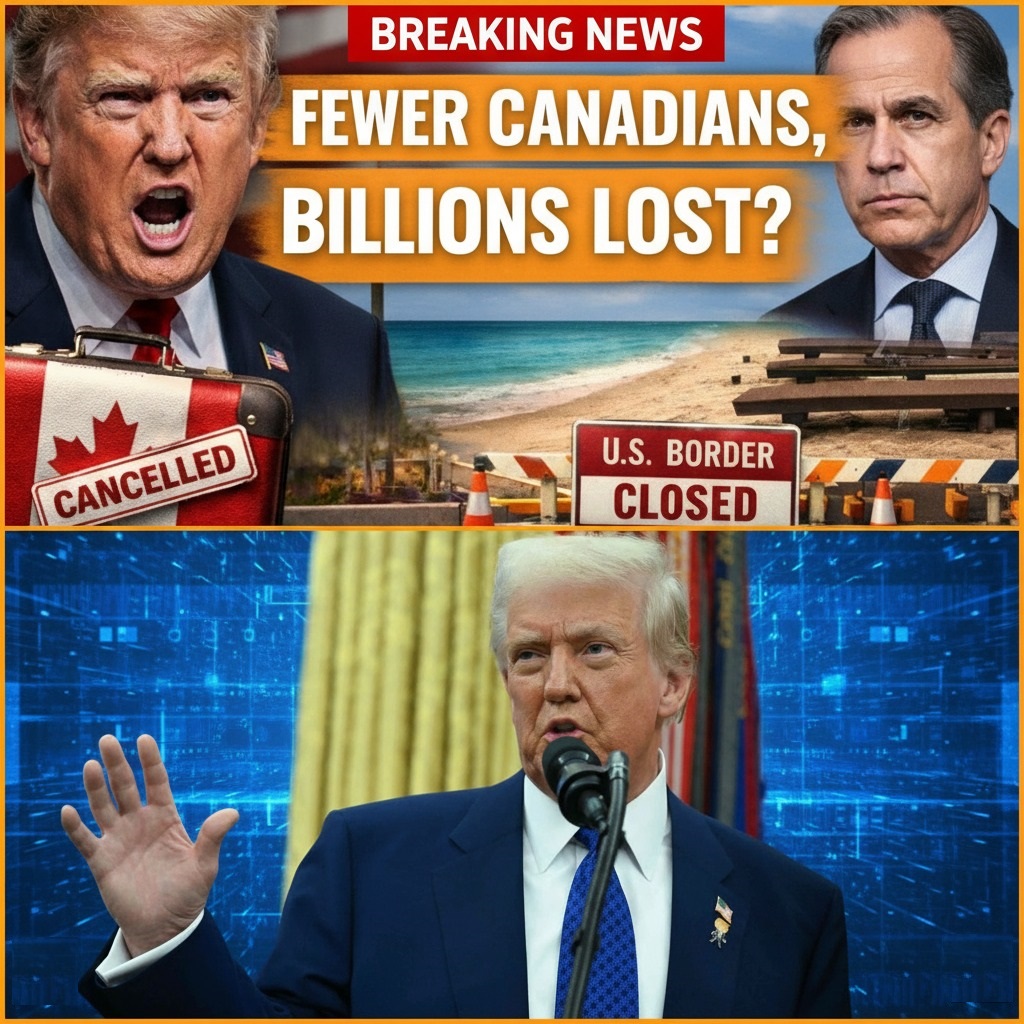
In 2025, the United States suffered a stunning $5.7 billion loss in tourism revenue, not from a recession or border restrictions, but from a quiet, collective decision made by millions of Canadians. With no boycott, no protests, and no official policy shift, Canada’s most loyal travelers simply stopped coming. Air travel fell by nearly a quarter. Land crossings dropped close to 30%. Border states reported their worst tourism years in decades. What triggered this silent withdrawal wasn’t economics—but emotion. And its impact may reshape North American travel habits for years to come.
For generations, Canadian tourists were the backbone of American tourism. They crossed the border for long weekends, summer vacations, outlet shopping, family visits, and winter escapes. Their presence was so reliable that many U.S. businesses built entire business models around Canadian traffic.
In 2025, that assumption collapsed.
According to travel data, Canadian air travel to the United States fell 24%, while land crossings dropped nearly 30%. In states like Maine and New Hampshire, tourism officials reported their worst seasons on record. In some regions, visitor numbers plunged by more than 40%, leaving hotels half-empty, restaurants understaffed, and local economies scrambling to adjust.
What makes this downturn remarkable is what did not cause it.
There was no organized boycott. No currency shock. No pandemic resurgence. Flights were affordable, borders open, and demand for travel remained strong. Canadians didn’t stop traveling—they simply chose not to travel to the United States.
The reasons lie deeper than price or convenience.
For many Canadians, the decision was emotional. Years of political rhetoric from Washington—particularly during Donald Trump’s leadership—left a lasting impression of disrespect and marginalization. Canada, long viewed as America’s closest ally and cultural neighbor, increasingly felt spoken about as a subordinate rather than a partner.
That tone mattered.
Rather than respond with outrage, Canadians responded with restraint. Millions made individual choices to redirect their spending away from a country they no longer felt welcome in. The result was a collective economic impact that rivaled a coordinated boycott—without ever being one.
Instead of Florida, Canadians booked Mexico. Instead of New York shopping trips, they chose Central America or Europe. Domestic tourism within Canada also surged, as national and provincial tourism boards encouraged residents to explore closer to home. Many travelers discovered alternatives that felt not only enjoyable—but affirming.
For the U.S. economy, the consequences were immediate and painful.
Canadians account for nearly 28% of all foreign visitors to the United States. Their absence rippled far beyond hotels and airlines. Restaurants, retail outlets, gas stations, ski resorts, and small family-owned businesses—especially in border states—felt the shock. Job losses followed, along with growing uncertainty in communities that had long depended on cross-border traffic.
American tourism officials moved quickly, launching discount campaigns and reassurance messaging aimed at Canadian audiences. The message was clear: you are welcome. But experts warn that trust is not rebuilt through promotions alone.
“This isn’t a pricing problem,” one industry analyst noted. “It’s a perception problem.”
And perception, once damaged, takes time to repair.
Perhaps the most concerning aspect is generational. Younger Canadians, watching their parents shift away from U.S. travel, are forming new habits. For them, the United States is no longer the default destination. Traditions that once included annual road trips or shopping weekends south of the border are quietly disappearing.
That shift may prove permanent.
The episode has also revealed a broader truth about modern economic power. In an interconnected world, influence is no longer exercised only through policy or trade agreements—but through consumer sentiment. Canadians learned in 2025 that their spending choices matter, and that silence can be just as powerful as protest.
For the United States, the lesson is sobering.
Economic strength does not rest solely on size, infrastructure, or branding. It depends on trust, respect, and the emotional bonds that draw people across borders. When those bonds fray, the consequences arrive quietly—but hit hard.
The $5.7 billion loss is more than a statistic. It is a signal.
In 2025, Canadians did not turn away in anger. They turned away calmly. And in doing so, they delivered one of the clearest reminders yet that in today’s global economy, goodwill is not optional—it is foundational.