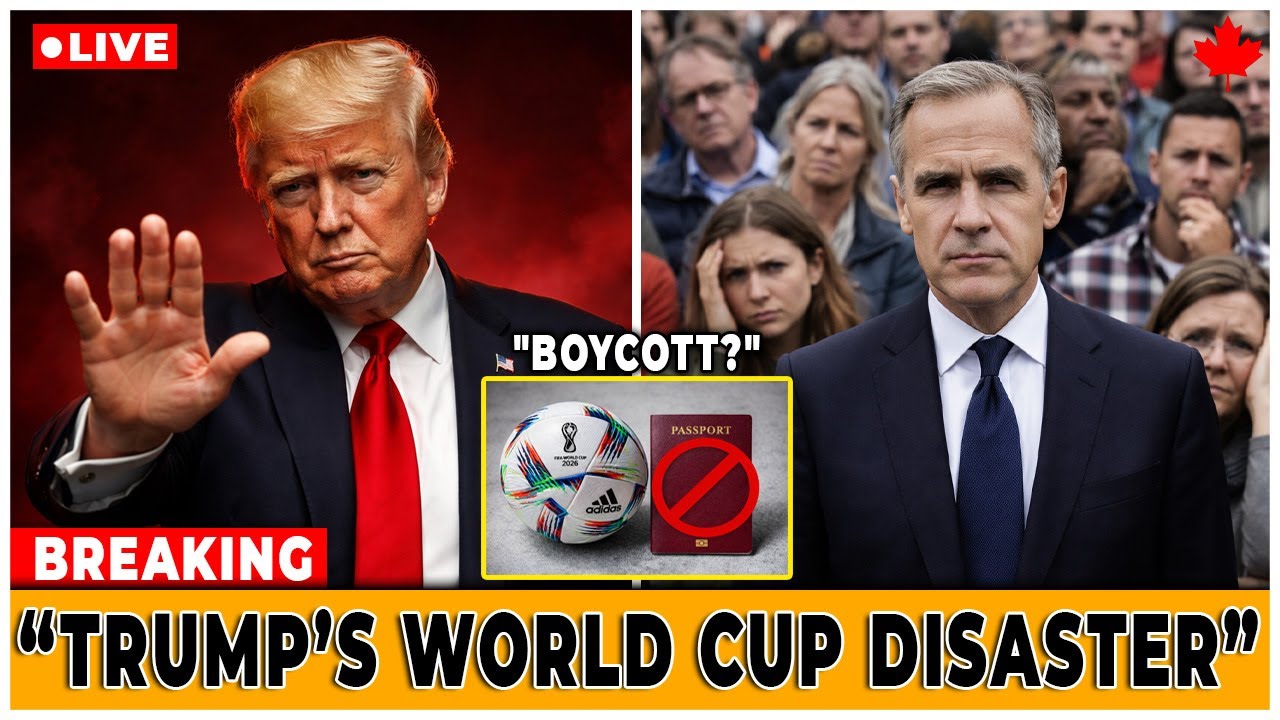
Rumors are exploding online that World Cup 2026 could be “cancelled.” That’s not what’s happening—but the panic isn’t coming from nowhere.
With kickoff now only months away, the tournament co-hosted by the United States, Canada, and Mexico has been hit by a policy shock out of Washington that’s colliding head-on with the entire point of a World Cup: fans traveling freely to follow their countries.
Here’s the verified core: in January 2026, the U.S. State Department began a sweeping policy to freeze immigrant visa processing for nationals of 75 countries, tied to an expanded “public charge” style enforcement approach.
That detail matters, because immigrant visas are not the same as short-term visitor visas. In other words, this doesn’t automatically mean “World Cup tourists are banned.”
In fact, travel and policy analysts have emphasized that the freeze is aimed at immigration pathways, not standard event travel—though the overall climate can still trigger delays, confusion, and fear for would-be visitors.
And fear is exactly the point.
Because in practice, the World Cup doesn’t run on technical distinctions. It runs on confidence. Fans book flights and hotels months in advance. Sponsors activate campaigns globally.
National teams expect their supporter sections to be loud, colorful, and full. When a host country becomes associated with visa freezes, enforcement uncertainty, or sudden policy swings, that confidence starts to evaporate—and the tournament begins to look less like a celebration and more like a geopolitical risk.
That’s why Europe even started floating the “boycott” word.
In late January 2026, debate inside Germany’s football leadership spilled into public view after comments suggesting a boycott should at least be considered as a political message.
But here’s the key reality check: Germany’s federation ultimately ruled out a boycott, explicitly saying it wants the World Cup to remain a unifying festival of football.
So no—Europe hasn’t “decided to walk away.” But the fact that this discussion surfaced at all tells you how tense the atmosphere has become.
At the same time, FIFA is trying to project calm. The U.S. State Department has also published public guidance urging fans who need visas to apply early and pointing to standard visa procedures for World Cup travel.
That messaging is basically a quiet admission of the new reality: border policy has become part of the tournament story.
And then there’s the headline-grabber: Trump receiving an inaugural FIFA peace-themed prize during a World Cup-related event.
That ceremony has been reported and defended by FIFA leadership, adding fuel to the perception that politics and prestige are mixing in ways that make the tournament feel even more volatile.
So what’s the real danger?
Not cancellation. Fragmentation.
If large numbers of fans feel blocked, delayed, or targeted—whether by actual visa barriers or simply by fear of enforcement—the U.S. venues risk a hollowed-out atmosphere.
And because Canada and Mexico are co-hosts, the ripple effect could be economically brutal: tourism money rerouting away from U.S. host cities toward Toronto, Vancouver, and Mexican venues, where some supporters may feel safer or face fewer hurdles.
That’s how you get a “ghost town” narrative without the tournament ever being officially cancelled.
Bottom line: World Cup 2026 is not cancelled. But the tournament is now living inside a trust crisis—where fans, federations, and governments are asking whether the host can still guarantee the basic promise of the World Cup: that the world is welcome.
And once that question is on the table, the damage isn’t measured in press releases—it’s measured in empty seats.