🔥 BREAKING: CANADA’S QUIET GRAIN STRATEGY RESHAPES A $780B TRADE LANDSCAPE — U.S. EXPORTERS FEEL THE SHIFT 🌾🇨🇦🇺🇸
In the flat expanse of Saskatchewan, where wheat fields stretch to the horizon and potash mines burrow deep beneath the prairie, Canada has long been an agricultural superpower that behaved like a junior partner.

For decades, much of the country’s grain and fertilizer exports — the backbone of a sector that shipped more than $99 billion in agricultural products in 2023 — moved through infrastructure it did not fully control. Western Canadian grain traveled by rail to Vancouver, a port increasingly plagued by congestion and labor disruptions, or crossed into the United States en route to American terminals. Fertilizer mined in Saskatchewan often rode U.S. railways before reaching global buyers.
That arrangement, once considered merely inefficient, is now being reconsidered as a strategic vulnerability.
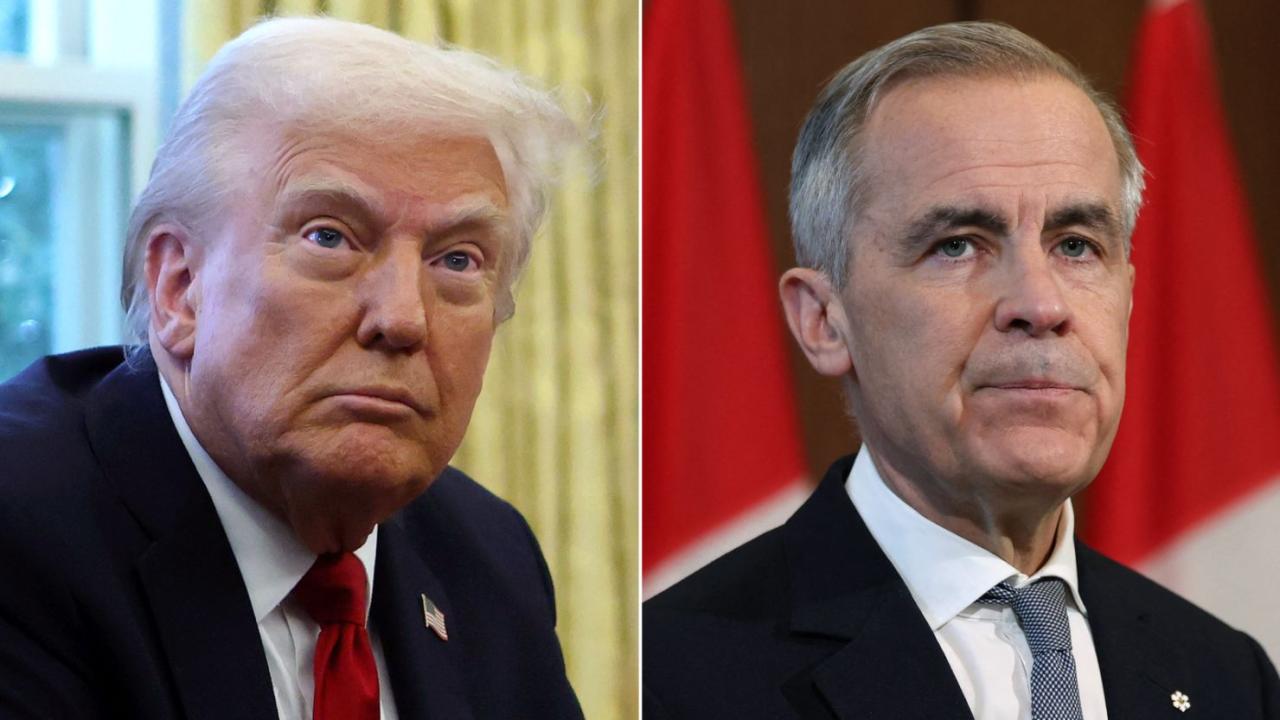
The shift began to crystallize in early 2025, amid renewed trade tensions with Washington. President Donald Trump threatened tariffs on Canadian agricultural goods, including grain and fertilizer, reviving anxieties across the prairie provinces. For farmers and provincial officials, the prospect of punitive levies underscored a deeper concern: Canada’s export lifelines were entangled with American logistics networks.
Into that debate stepped Prime Minister Mark Carney, who, speaking to growers in Saskatchewan, posed a blunt question: Why was a country so rich in agricultural resources still outsourcing its access to world markets?
The answer, some policymakers argue, lies nearly 1,000 miles north of the border crossings and Pacific terminals that have long dominated Canadian trade routes.
The Port of Churchill, perched on the western shore of Hudson Bay, was built in the 1930s as a gateway to Europe. On a map, it offers a striking advantage: shipments to European markets can be several days shorter than routes through Vancouver and the Panama Canal. A 1,300-kilometer rail line connects the port directly to the Prairie grain belt.
Yet for most of its history, Churchill has operated only seasonally, constrained by ice and underinvestment. In 1997, the federal government sold the port and rail line to an American firm for a symbolic sum. Years of neglect followed. After flooding damaged the rail line in 2017, the private owner walked away, and the port fell silent.
It was revived in 2018 when a coalition of 41 First Nations communities and northern Manitoba towns purchased the assets, forming the Arctic Gateway Group. At the time, the acquisition was seen as an act of regional determination rather than a national turning point.
Now, amid trade uncertainty and climate change that has gradually lengthened the Arctic shipping season, Churchill is being recast as a pillar of Canada’s economic sovereignty.
In March 2025, Genesis Fertilizers announced a partnership with Arctic Gateway Group to route both imports of raw materials and exports of finished nitrogen fertilizer through Churchill. The company is planning a facility capable of producing one million tons of fertilizer annually. Historically, key inputs such as phosphate would have transited U.S. ports. Under the new plan, they would arrive directly via Hudson Bay.
The logic, executives say, is commercial rather than political: shorter routes to Atlantic markets, fewer transfer points and insulation from abrupt policy changes south of the border.
But the implications are unmistakably geopolitical.
Canada supplies roughly one-third of the world’s potash and is a leading exporter of high-protein wheat, canola and pulses. Even a modest redirection of those volumes northward could reshape trade flows. Government and industry estimates suggest that over a decade, hundreds of billions of dollars in grain, fertilizer and potentially critical minerals could move through Churchill if planned expansions proceed.
Federal officials have pledged 180 million Canadian dollars over five years for upgrades, while provincial leaders in Saskatchewan and Alberta have framed the port as central to diversifying export routes. Planned improvements include expanded grain-handling facilities, increased rail capacity and investments aimed at extending the shipping season.
The ambition is not to replace Vancouver, Canada’s largest port, but to create redundancy — and leverage.
“Control follows ownership,” one provincial official said privately, summarizing the rationale. When exports depend on foreign infrastructure, so does negotiating power. When supply chains remain domestic, policymakers argue, resilience increases.
The project faces formidable obstacles. The rail line crosses thawing permafrost, raising maintenance costs. Churchill, with a population under 1,000, must attract labor and housing investment to support growth. Icebreaker capacity in Hudson Bay remains limited, and the Arctic climate is unpredictable.
Skeptics note that previous efforts to transform Churchill into a major trade corridor faltered under harsh economic realities. Global grain markets are intensely competitive, and shipping efficiencies can be quickly offset by weather disruptions.
Still, momentum appears stronger than in past revivals. Elevated global shipping costs, persistent congestion at established ports and rising geopolitical tensions have altered the calculus. Private capital has committed to specific projects, and fertilizer volumes are expected to begin ramping up within the next two years.
For the United States, the consequences would be gradual rather than catastrophic. American railways and ports would continue to handle substantial Canadian trade. But a share of the fees and influence long embedded in cross-border logistics could diminish as supply chains shift north.
For Canada, the gamble is larger. Revitalizing Churchill is not merely an infrastructure project; it is a test of whether a resource-rich nation can convert latent power into strategic autonomy.
On the windswept shore of Hudson Bay, where grain elevators stand against Arctic skies, that experiment is already underway.