The world expected another round of tariff threats.
What it got instead was the quiet unraveling of North America’s most powerful economic partnership.
In the early hours of August 1, 2025, former U.S. President Donald Trump signed an executive order that seemed, at first glance, like just another aggressive trade maneuver. The tariffs on Canadian imports would jump from 25% to 35%, a move framed by Washington as proof of economic strength and negotiating power.
Trump even celebrated the decision publicly, boasting that his policies were bringing “trillions of dollars” into the United States.
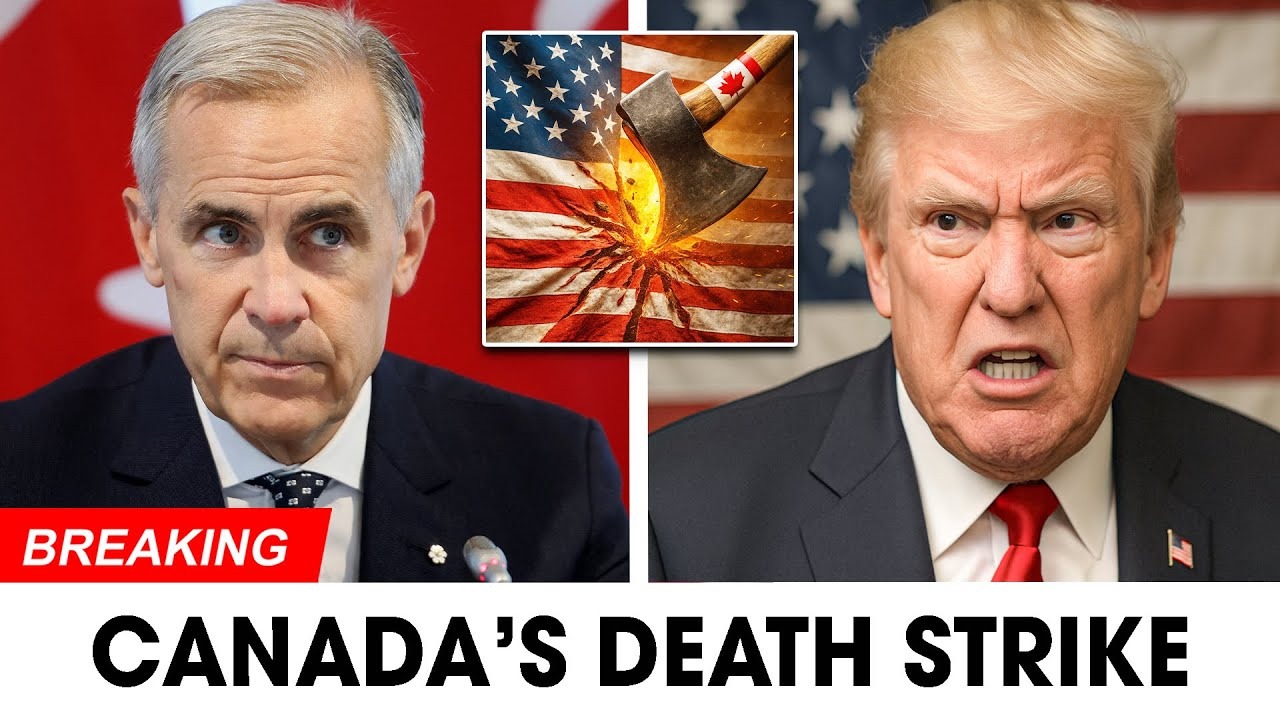
But across the border, Canada wasn’t preparing a loud retaliation. There were no fiery speeches, no dramatic threats. Instead, Ottawa executed something far more unsettling: a silent counterstrike that began reshaping the global economic map.
Within days, the consequences started appearing in places Americans least expected—their wallets.
A children’s hoodie that once sold for $6.98 suddenly cost nearly $11. Everyday goods climbed in price. Weekend travel to cities like Toronto or Montreal became noticeably more expensive. Supply chains began to shudder.
But the most visible shock came from tourism.
For decades, Canadians had quietly fueled local economies across the United States—especially in states like Florida, where winter visitors from the north are practically an economic pillar. Every year, roughly 3.4 million Canadians travel there, pouring over $6 billion into the state through long-term condo rentals, restaurants, and leisure spending.
In 2025, that stream began to dry up.
Border crossings dropped dramatically—by nearly a third. Condo complexes that once filled with Canadian snowbirds sat empty. Restaurant owners complained of lost revenue. Local officials started appearing on television urging Washington to de-escalate the trade conflict.
Meanwhile, Ottawa remained remarkably calm.
This was not an impulsive response. It was part of a deeper strategy designed by Prime Minister Mark Carney, a veteran of global financial crises who previously led both the Bank of Canada and the Bank of England.
Carney understood something Washington seemed to underestimate: the true leverage Canada holds over the future of global technology and energy.
Over the previous year, Canada had already begun quietly reducing its dependence on U.S. markets. Between May 2024 and May 2025, the share of Canadian exports going to the United States dropped from 78% to 68%—an extraordinary shift in just twelve months.
New trade partnerships rapidly expanded.
Canadian gold exports to the United Kingdom surged by more than 470%. Trade ties deepened with the European Union, Japan, Mexico, and Australia. Supply networks were quietly diversifying.
But the real turning point involved critical minerals.
Canada holds enormous reserves of lithium, cobalt, nickel, and rare earth elements—the materials powering the technologies of the future. Electric vehicles, wind turbines, smartphones, satellites, and advanced defense systems all rely on these resources.
Until now, much of the world depended heavily on China, which controls roughly 80% of rare earth refining capacity.
Canada saw an opportunity.
Rather than exporting raw minerals, Ottawa accelerated investment in domestic processing facilities, allowing it to sell refined, ready-to-use materials directly to allied nations. Contracts were signed. Mining permits were fast-tracked.
Suddenly, Canada was no longer just a resource supplier—it was becoming a strategic hub in the global tech supply chain.
Ironically, this shift alarmed Washington.
The U.S. defense industry, including programs such as F-35 fighter jets and advanced radar systems, relies heavily on these same materials. Without access to reliable mineral supplies, key technologies could face delays or rising costs.
Yet the tariffs had been placed on the very ally capable of helping the United States reduce dependence on China.

While this geopolitical chess match unfolded, everyday Americans began feeling the pressure.
Automobile prices rose 4–8%. Clothing and footwear costs surged by nearly 40% in some cases. Major companies, from Ford to Procter & Gamble, warned that tariffs were already costing billions and forcing price increases on basic household goods.
Supply chains stretching across the U.S.–Canada border—once considered the most seamless in the world—started to fracture.
The irony was stark. Industries in states like Michigan, Washington, New York, and Montana were among the hardest hit, as cross-border manufacturing networks stalled.
Meanwhile, Canada continued expanding its global partnerships.
The European Union secured agreements for critical minerals. Asian markets began absorbing Canadian resources. London strengthened financial ties. The quiet shift suggested something bigger than a trade dispute.
It hinted at a new economic order.
For more than a century, the relationship between Canada and the United States had been built on deep trust and integration. Factories operated across borders, parts crossed back and forth multiple times before final assembly, and the longest peaceful border on Earth symbolized economic stability.
Now that system appeared fragile.
What began as a tariff increase had evolved into something far more consequential—a test of whether the North American alliance itself could survive a new era of economic nationalism.
The question facing both countries is no longer about tariffs.
It is about whether a partnership built over 150 years can withstand the pressures of modern geopolitical competition.
And as global powers watch closely—from Beijing to Brussels—the outcome may shape the next chapter of the world economy.