China’s decision to impose a punishing tariff of nearly 76 percent on Canadian canola has sent shock waves through Ottawa and across the Prairie provinces, instantly turning a trade dispute into a national political test. Officially, Beijing claims Canada has been dumping canola into the Chinese market. Unofficially, few in Canada doubt the move is retaliation, a geopolitical response to Ottawa’s earlier decision to slap a 100 percent tariff on Chinese-made electric vehicles.
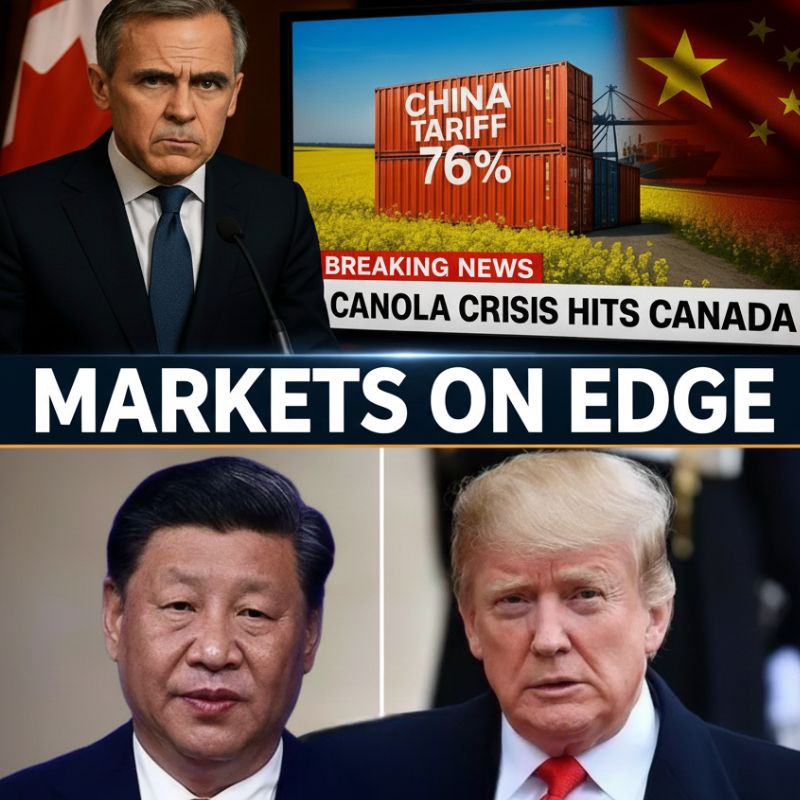
The economic stakes are enormous. Canola is a cornerstone of Canadian agriculture, generating roughly $5 billion in annual exports, with China historically one of its largest buyers. Nearly six million tons of seed that once flowed east across the Pacific now risk sitting unsold as harvest season approaches. Prices are already sliding, storage facilities are filling, and farmers in Saskatchewan and Alberta fear a financial squeeze that could last years, not months.
For producers on the Prairies, the anger is visceral. They had little say in Ottawa’s EV tariff strategy, a policy designed primarily to protect auto manufacturing in Ontario and Quebec and to align Canada more closely with U.S. trade policy under Donald Trump. Yet it is Western farmers, not central Canadian automakers, who are absorbing the blow from Beijing’s retaliation. The sense of regional imbalance is reviving old political resentments and deepening distrust toward the federal government.
That dynamic has transformed the canola dispute into a domestic unity problem as much as an international one. Analysts warn that prolonged low prices could hollow out rural communities, force smaller farms out of business, and accelerate consolidation across the agricultural sector. What began as a trade skirmish now threatens to widen the fault lines between Ottawa and the West at a particularly fragile economic moment.
Prime Minister Mark Carney has responded with restraint rather than retaliation, a choice that has drawn both praise and criticism. He has rejected Beijing’s dumping accusations, spoken directly with Saskatchewan Premier Scott Moe, and promised financial support for affected farmers. Crucially, Carney has signaled that Canada will prioritize diplomatic engagement with China instead of launching counter-tariffs that could escalate the conflict.
Critics, led by opposition leader Pierre Poilievre, argue that this approach projects weakness. Poilievre has accused Carney of failing to fight for farmers, amplifying frustration already simmering across the Prairies. Yet Carney’s allies insist the prime minister is playing a longer game, one shaped by the uncomfortable reality that Canada is under pressure from both of its largest trading partners at the same time.
With Donald Trump back in the White House and reimposing tariffs on Canadian goods, reliance on the United States looks increasingly risky. Retaliating aggressively against China, Carney believes, could leave Canada trapped in simultaneous trade wars with two economic superpowers. His refusal to escalate is a calculated gamble that diplomacy and negotiation will yield faster relief than confrontation.
Diversification sits at the heart of that strategy. Ottawa is accelerating efforts to expand agricultural exports to Europe, Southeast Asia, Africa, and South America, aiming to reduce dependence on any single market. These efforts, however, cannot deliver immediate relief. Farmers still have crops to harvest, store, and sell, often at painful discounts that threaten already thin margins.
Whether Carney’s bet pays off remains uncertain. If diplomacy succeeds and tariffs are eased, Canada could emerge more resilient and less exposed to future shocks. If it fails, Prairie farmers may face one of the most difficult seasons in modern memory, and Carney’s leadership will come under intense scrutiny. One thing is already clear: the canola crisis is not just about a crop, but about Canada’s place in an increasingly volatile global trading system—and how it chooses to defend itself within it.






