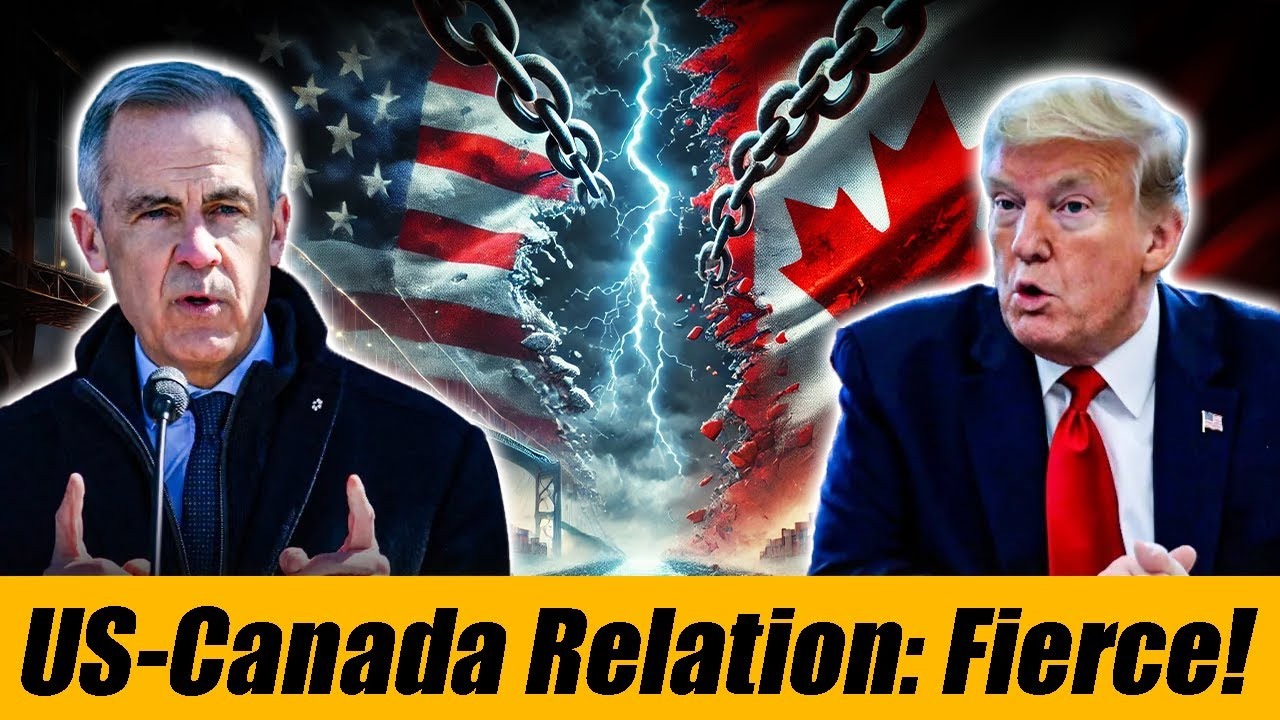
In a striking assertion of geopolitical tension, former President Donald Trump has reignited his contentious relationship with Canada, warning that the U.S. could face dire consequences should it continue to disregard its northern neighbor’s crucial role in the energy landscape. Trump’s recent remarks on the global stage underscore a precarious reality: the U.S. energy grid is at risk, and American industries are more dependent on Canadian resources than many may realize.

The U.S. currently produces about 13 million barrels of oil per day while consuming nearly 19 million, creating a significant gap that Canadian imports fill. Alarmingly, 62% of the crude and natural gas flowing into U.S. refineries originates from Canada, with a staggering 75% of Midwest refinery inputs relying on Alberta’s heavy oil. This dependency is not merely a convenience; it is a necessity that, if disrupted, could send shockwaves through the American economy.
Earlier this year, the U.S. imposed a sweeping 25% tariff on a wide array of Canadian goods, yet Alberta’s oil was given a mere 10% levy. This exemption serves as a stark warning: American industry is intricately linked to Canadian crude. Disrupting this supply could lead to soaring gasoline prices, particularly in the Midwest, where the impact would be felt most acutely. Analysts predict that extending tariffs to Canadian oil could trigger price surges of 15% to 20%, exacerbating inflation and straining consumers.
The structural lock-in effect of U.S. refineries, designed specifically for Canadian crude, complicates any swift pivot to alternative suppliers. Such a transition would entail exorbitant costs and operational disruptions, further entrenching the U.S.’s vulnerability in global energy markets. Meanwhile, Canada is strategically repositioning itself, transitioning from a mere supplier to a pivotal player in the energy arena. The completion of the Trans Mountain expansion, which triples pipeline capacity, enables Canadian oil to bypass the U.S. entirely, allowing it to reach international markets and reducing dependency on American consumption.
Canada’s energy exports have surged, particularly to China, reflecting a growing ability to diversify markets and reduce reliance on the U.S. The first half of 2025 saw Canadian energy exports to Asia soar by 81%, highlighting a strategic shift that positions Canada as a reliable supplier amid global volatility. This transformation is not merely economic; it is a recalibration of power dynamics in North America.

As the U.S. grapples with its own energy infrastructure and protectionist policies, Canada’s methodical approach emphasizes flexibility and long-term leverage. Prime Minister Mark Carney’s government is keenly aware of the stakes involved. Recent infrastructure initiatives, including a liquefied natural gas plant and new mining projects, aim to bolster domestic capacity and reduce vulnerability to foreign trade pressures.
However, this accelerated approach has sparked controversy, particularly among environmentalists and indigenous groups concerned about potential ecological impacts and land rights. Carney’s administration insists on balancing urgency with inclusivity, pledging to involve local communities in decision-making processes.
In summary, the unfolding narrative of North American energy is characterized by contrasts. While the U.S. resorts to tariffs and trade wars, Canada is cultivating corridors of reliability and trust. The implications of this shift are profound, as Canada emerges as a stabilizing force in a fractured global economy. As the energy landscape continues to evolve, the stakes are higher than ever, with the potential for significant economic ramifications on both sides of the border. As tensions rise, the question remains: how will the U.S. navigate its energy dependency, and can it adapt to a new reality where Canada holds the keys to stability and influence?