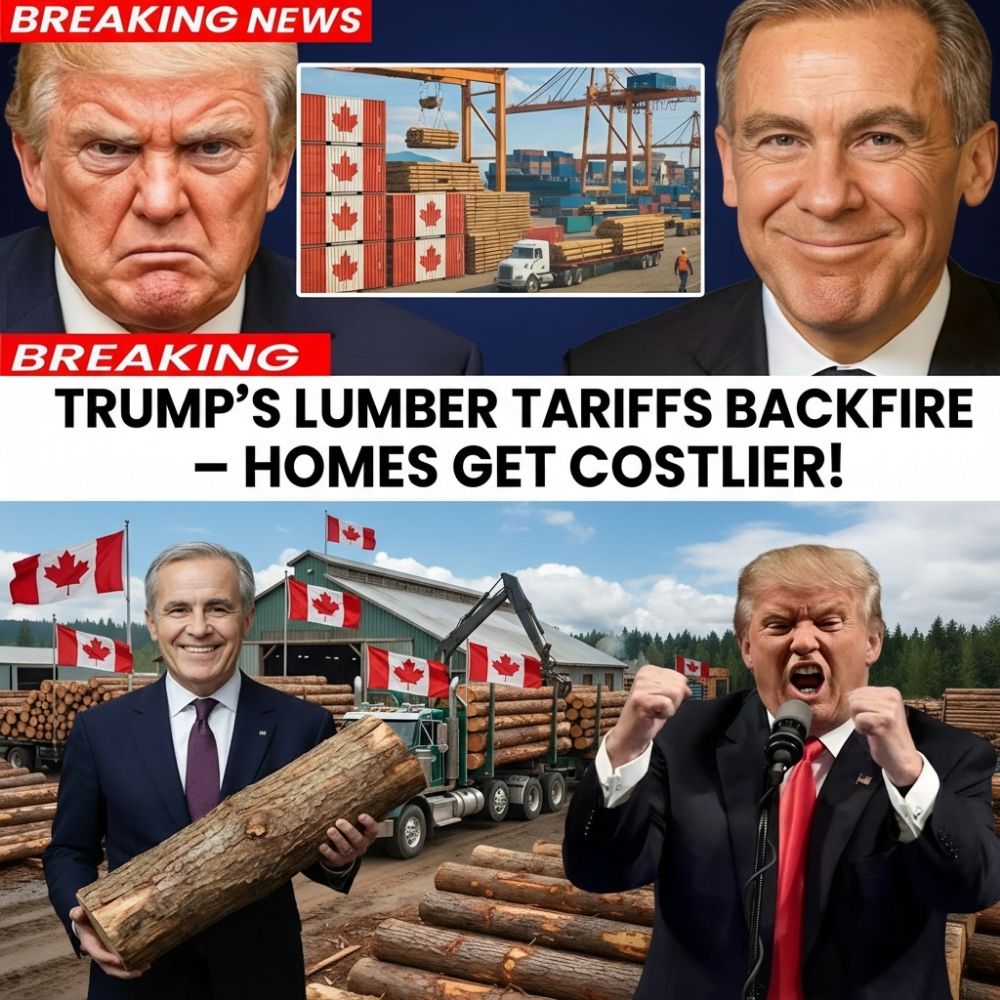
Donald Trump’s lumber tariffs were supposed to squeeze Canada into submission. Instead, they triggered a transformation that may permanently weaken U.S. leverage—and expose the bluff at the heart of Trump’s trade strategy.
At the center of this shift is an unexpected pivot: Canada’s lumber industry is moving decisively toward the metric system, aligning itself with Asia and Europe while quietly loosening a century-old dependence on the United States.
For decades, Canadian forestry lived in a strange contradiction. Canada officially adopted the metric system in the 1970s, yet its lumber mills kept cutting wood in feet and inches.
Why? Because nearly 90% of Canadian softwood lumber flowed to the United States, a country locked into the imperial system. There was no incentive to change—until Washington made itself unreliable.
That changed in 2025.
When Trump returned to office and revived his aggressive tariff agenda, Canadian softwood lumber became an early target. Duties surged past 45%, hammering spruce, pine, and fir—the backbone of North American homebuilding.
The immediate damage was real: layoffs in British Columbia and Alberta, temporary mill shutdowns, and mounting uncertainty across the sector.
But instead of retreating, Canada recalculated.
Industry leaders testifying before Parliament delivered a blunt conclusion: the U.S. could no longer be treated as a stable market. Political risk had replaced predictability. Meanwhile, demand was growing elsewhere—Japan, South Korea, India, Vietnam, and the European Union. There was just one catch: all of them operate strictly in metric.
Trump’s tariffs forced a decision no one expected—a full industrial shift.
Retooling a single mill to metric standards can cost up to $2 million, with equipment delivery timelines stretching as long as three years. It’s expensive, disruptive, and slow. But it also unlocks access to markets representing billions in long-term demand. What began as emergency adaptation is now becoming a strategic reset.
And while Canada invests, the United States is absorbing the fallout.
The most uncomfortable truth in this trade fight is simple: America needs Canadian lumber far more than Canada needs American tariffs. Reuters has reported rising costs for U.S. homebuilders tied directly to reduced Canadian imports.
Bloomberg highlighted an even more jarring detail—Russian lumber is now cheaper for U.S. buyers than Canadian wood under Trump’s tariff regime.
But cheaper doesn’t mean better.
Russian and Scandinavian suppliers cannot match Canada’s scale, consistency, or environmental standards. As a result, builders across Texas, Michigan, Washington, and Ohio are reporting double-digit lumber price increases, delayed projects, and worsening affordability.
This pressure lands on an industry already strained by high interest rates and a housing crisis.
So the question becomes unavoidable: who did these tariffs actually protect?
Canada, meanwhile, is leaning into diversification under Prime Minister Mark Carney. If mills must convert to metric, the logic is clear—don’t just survive the transition. Use it to re-enter the global market on stronger footing.
Japan’s premium housing sector demands high-grade lumber, and Canadian SPF fits perfectly. South Korea’s construction boom needs reliable supply. India’s urban expansion is one of the largest growth stories on Earth. Vietnam’s furniture manufacturing sector is exploding. Europe, with its strict standards and high margins, remains a prize market.
Trump wanted to isolate Canada.
Instead, he accelerated its globalization.
There’s a deeper irony here. Canada is modernizing its industrial base, upgrading machinery, and aligning with the measurement system used by most of the world. The United States, meanwhile, is moving inward—raising domestic costs and turning to geopolitically risky suppliers to fill gaps created by its own policies.
Politically, tariffs play well at rallies. Economically, they don’t care about applause.
As the 2026 USMCA renegotiation looms, Canada enters the next phase of trade talks from a radically different position. Its reliance on the U.S. is shrinking. Its global leverage is growing. And American consumers are already paying the price for protectionism.
Trump’s lumber tariffs were meant to wound Canada.
Instead, they exposed the bluff.
Canada didn’t shout. It didn’t retaliate theatrically.






