In a tense broadcast that blended breaking-news urgency with revival-style conviction, Franklin Graham delivered a stark assessment of the unrest unfolding in Minneapolis, urging Americans to view the crisis not merely as a political or legal dispute, but as a moral and spiritual reckoning for the nation.
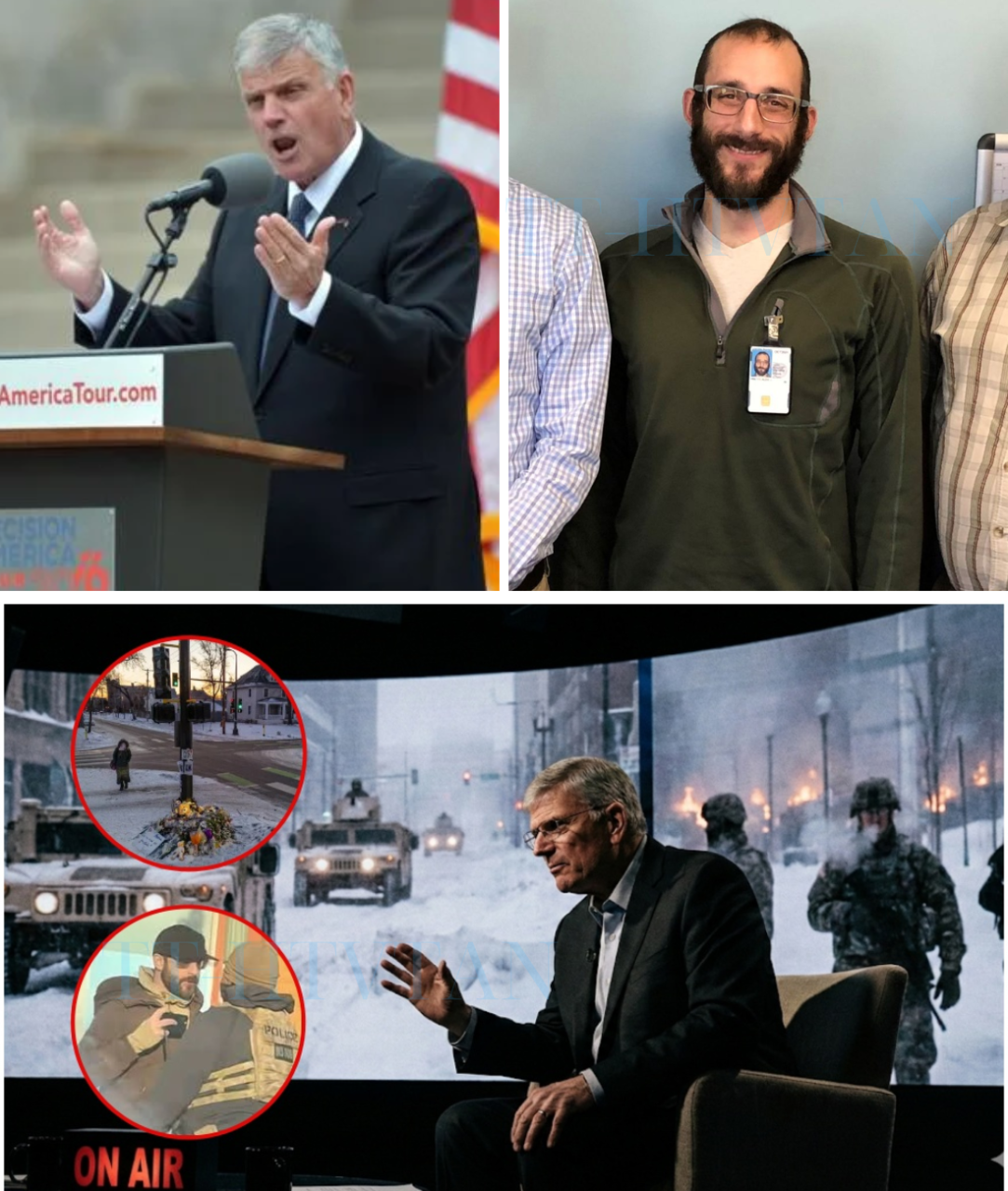
The segment opened with images of snow-choked streets and armored vehicles stationed along Nicollet Avenue, National Guard troops visible through clouds of frozen breath as winter winds cut across the city. Graham, speaking in a low, deliberate tone, described a city “freezing over, yet burning with a fire that is not of this world,” setting the tone for remarks that would quickly ripple across social media and cable news panels.
At the center of the unrest is the death of Alex Pretti, a nurse whose fatal encounter with federal agents during a cold-weather operation has ignited days of protests and renewed debate over federal law enforcement’s role in American cities. Graham paused to acknowledge the human cost of the incident, calling Pretti “a son, a healer, a nurse,” and offering prayers for his family. “That is a grief no parent should bear,” he said, momentarily removing his glasses in a gesture of mourning.
But the sympathy quickly gave way to warning. Graham argued that Pretti’s death, while tragic, is being “hijacked by a spirit of rebellion” intent on tearing the country apart. According to Graham, the demonstrations erupting across Minneapolis are less about justice and more about vengeance, fueled by what he described as a broader cultural rejection of authority.
The host of the program challenged Graham with criticism from Minnesota’s leadership, noting that Tim Walz has characterized the federal presence in Minneapolis as an overreach that escalated tensions rather than calmed them. Graham dismissed that framing, saying the governor was viewing the crisis through a political lens while he himself was looking at it spiritually.
“You have federal agents in that city because local leaders surrendered the streets long ago,” Graham said. “When you abdicate your duty to maintain order, you invite chaos.”
In Graham’s telling, the deployment of federal forces was not the cause of disorder but the response to it. He described the fatal encounter as a “split-second decision in the bitter cold,” insisting that one incident should not be used to condemn an entire system of law enforcement. To do so, he argued, risks undermining the fragile line between what he called “civilization and savagery.”
Central to Graham’s message was a theological argument rooted in Romans 13, a biblical passage often cited in debates over civil authority. Government, he said, is ordained by God to “wield the sword against evil.” While acknowledging that officers are imperfect and fallible, Graham maintained that portraying law enforcement as the enemy is “a lie from the pit,” language that echoed the fire-and-brimstone rhetoric familiar to his supporters.
The protests themselves, Graham argued, reveal their true nature by their outcomes. “You look at the fruit,” he said. “Is the fruit of these protests peace? Is it healing? No. It is division.” In his view, anger directed at federal buildings and officers serves only to deepen national wounds, not to heal them.
Civil liberties advocates and protest organizers see the situation very differently. They argue that demonstrations are a necessary response to what they view as unchecked federal power and a lack of accountability in Pretti’s death. Many have emphasized the largely peaceful nature of the protests, accusing federal agents of escalating confrontations and chilling free expression. Graham did not directly address those claims, instead framing the unrest as evidence of a broader spiritual vacuum.
“The enemy of our souls loves a vacuum,” he said. “He loves it when we tear down our protectors.” Removing federal forces from Minneapolis, Graham warned, would not lead to harmony but to “hell on earth,” a phrase that underscored his apocalyptic framing of the crisis.
As his remarks drew to a close, Graham’s tone softened, though the urgency remained. He urged Americans to mourn Pretti sincerely while resisting what he described as the politicization of grief. “Without law, there is no mercy,” he said. “Without order, there is no justice.”
For supporters, Graham’s words offered clarity in a confusing moment, affirming a worldview in which social unrest reflects spiritual decay and order is a prerequisite for compassion. For critics, the broadcast exemplified how religious language can be used to legitimize aggressive state power and dismiss legitimate dissent.
What is clear is that Graham’s sermon-like address tapped into a deep national divide—over policing, protest, and the meaning of justice itself. As Minneapolis remains under heavy security and investigations into Pretti’s death continue, the debate Graham amplified shows no sign of cooling, even as the city itself remains locked in winter’s grip.
In the dimming studio lights, Graham delivered his final appeal not to lawmakers or protest leaders, but to the public watching at home. The solution, he said, would not be found in shouting at buildings or clashing in the streets, but in kneeling before God. Whether that message brings comfort or controversy, it has become another defining voice in a moment when America is still struggling to decide how to grieve, how to protest, and how to hold power to account.