When Donald Trump declared that the United States no longer needs cars made in Canada, the comment sounded like classic political bravado. Delivered on the floor of a Michigan auto plant, surrounded by American workers, it was meant to project strength, independence, and economic dominance.
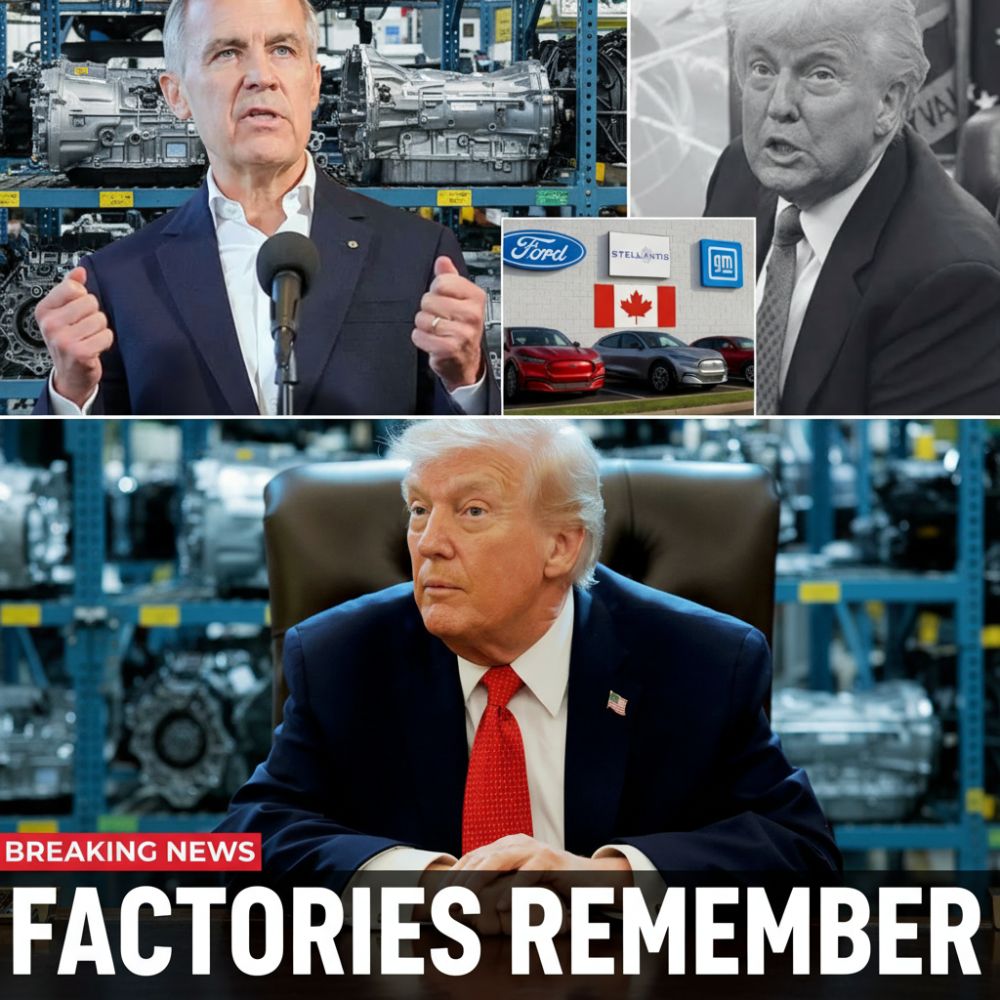
Instead, it detonated a reality Washington rarely admits: the U.S. auto industry cannot function without Canada.
Trump’s blunt dismissal of Canadian-made vehicles—and of the USMCA framework that binds North America’s auto supply chain—opened a new front in an already volatile trade war. He called the agreement irrelevant. He said America doesn’t need Canadian or Mexican cars. But behind the rhetoric, industry leaders and economists saw something far more dangerous: a system being shaken at its weakest point.
North America’s auto industry is not national. It is integrated, engineered over decades for efficiency, predictability, and scale. Engines built in Ontario cross the border multiple times before landing inside best-selling American trucks like the Ford F-150. Tooling from Canada feeds assembly lines in Michigan. Steel from the Midwest flows north and south in a tightly choreographed loop.
Disrupt one link, and the entire chain seizes.
Trump’s remarks landed at the worst possible moment. The 2026 review of the USMCA agreement is approaching, supply chains are already strained, and tariff pressure has intensified throughout 2025. In Windsor alone, more than 20,000 workers depend on uninterrupted cross-border production. What Trump framed as leverage sounded to industry insiders like a self-inflicted shock.
And Canada didn’t blink.
Instead of panicking, Ottawa quietly fired back—not with tariffs or threats, but with strategy. Prime Minister Mark Carney’s government has been accelerating a deliberate pivot away from total reliance on the U.S. market. Trade and industrial ties with Japan, South Korea, and Europe are expanding. Investment in EV batteries, clean energy, hydrogen, and critical minerals is accelerating. Canada is building alternatives.
That shift changes everything.
In 2018, Canada entered negotiations with few options. In 2026, it arrives with leverage. If Washington pushes too hard, Canada and Mexico now have room to coordinate, demand stronger dispute protections, and shield themselves from U.S. volatility. The architecture of the agreement itself allows for that recalibration.
Trump’s argument also collapses under its own math. Canada is the largest export market for U.S.-made vehicles. If Canada stops buying American cars, the damage hits the Midwest immediately. Auto executives know this. That’s why they are increasingly vocal about the danger of unpredictability. The auto sector plans in decades, not news cycles. Tariff shocks don’t bring factories home—they freeze investment.
History backs this up. After major tariff escalations, U.S. manufacturing employment tends to fall, not rise. Companies delay decisions. Costs rise. Global competitiveness erodes. Meanwhile, rivals in Europe and Asia consolidate power, scale EV production, and lock in supply chains while North America argues with itself.
The irony is brutal: Trump’s attempt to project dominance is weakening America’s position.
Canada, by contrast, is leaning into something far more powerful than retaliation—credibility. Investors increasingly see Canada as a stable, predictable, open economy in a world of chaos. Energy experts describe the country as “sitting pretty,” with resilient oil and gas markets, expanding LNG access to Asia, and a rapidly growing renewable sector.
International capital is paying attention.
While U.S. policy whiplashes with every tariff threat, Canada offers consistency. Regulations may be strict, but they are reliable. Incentives are clear. Long-term planning is possible. In a trade war, that steadiness becomes a weapon.
The political fallout may land first in Michigan. Thousands of American jobs depend on Canadian engines, parts, and tooling. When Trump dismisses USMCA as irrelevant, he is dismissing the very system keeping those towns alive.
The deeper truth is impossible to ignore: America’s automotive strength has always depended on Canada’s stability. Push Canada too far, and Ottawa will continue doing exactly what it’s doing now—diversifying, partnering, and positioning itself to thrive regardless of Washington’s mood.
This confrontation is no longer about rhetoric. It’s about whether the United States chooses strategy or spectacle. Because if the North American auto system truly fractures, the collapse won’t start in Ottawa.
It will start at home.