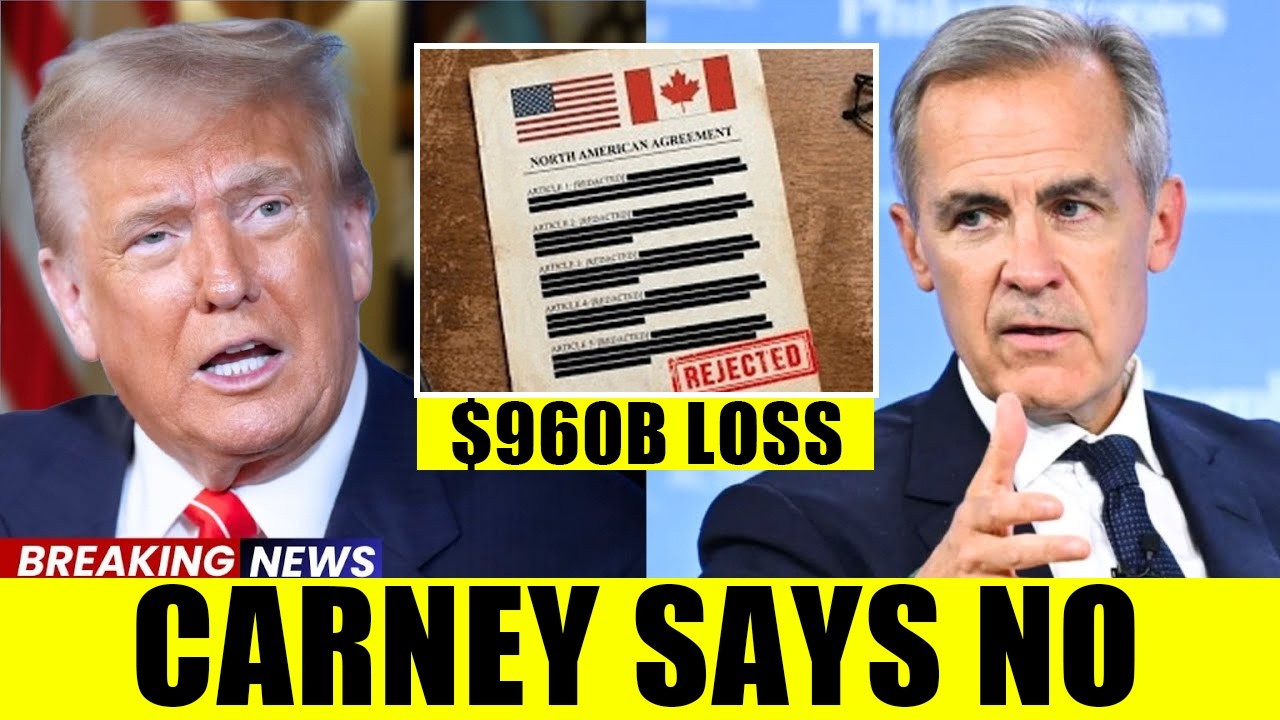
Trump Demands Five Major Concessions — Carney Rejects Them All
Power politics rarely unfold this openly.
In a sweeping move, Washington delivered five formal demands to Canada—each targeting a critical pillar of its economy: dairy, digital media, provincial trade retaliation, government procurement, and energy. The expectation in diplomatic circles? Quiet negotiations. A softened tone. A behind-the-scenes compromise.
Instead, Canadian Prime Minister Mark Carney rejected every single demand—publicly and without hesitation.
What followed wasn’t a shouting match. It was something more serious: a calculated standoff built on leverage, interdependence, and long-term positioning.
1️⃣ Agriculture: The Dairy Flashpoint
At the top of Washington’s list was Canada’s supply management system for dairy.
U.S. producers have long criticized the system, arguing that it restricts American exports through strict quotas and tariffs that can exceed 200% once limits are reached. Washington pushed for expanded access, framing the structure as unfair.
Carney didn’t budge.
He defended supply management as essential to protecting Canadian farmers and rural communities. The system is reinforced by legislation, making rapid reversal politically and legally difficult. For Ottawa, this wasn’t just trade policy—it was food security and domestic stability.
The message: Canada’s agricultural framework is not up for sale.
2️⃣ Digital Media: Big Tech vs. Cultural Protection
Next came Canada’s digital laws.
The Online Streaming Act requires major platforms operating in Canada to invest a portion of their revenue into Canadian content. The Online News Act compels large tech firms to compensate publishers when news content is shared on their platforms.
Washington argued these rules unfairly target American tech giants and act as digital trade barriers.
Ottawa called them cultural safeguards.
Without intervention, Canadian media companies risk being overwhelmed by global platforms. Carney made it clear: cultural sovereignty is not a bargaining chip in trade negotiations.
3️⃣ Provincial Retaliation: Alcohol and Reciprocity
After U.S. tariffs were imposed on certain Canadian goods, several provinces responded by limiting the sale of American alcohol in government-run liquor stores.
Washington demanded those restrictions be lifted.
Carney’s answer was blunt in principle, even if measured in tone: tariffs came first. Provincial countermeasures came second. Remove the tariffs, and retaliation can be discussed.
Trade operates on reciprocity. Canada signaled it would not absorb economic penalties without response.

4️⃣ Government Procurement: A Mirror Held Up
Washington also accused Canadian provinces—such as Ontario, Quebec, and British Columbia—of favoring domestic suppliers in public contracts.
But the United States maintains its own “Buy American” policies, prioritizing domestic firms for federal infrastructure and defense projects.
Carney responded not with outrage, but comparison.
Public procurement shapes industrial capacity and employment. Ottawa refused to dismantle its internal economic tools without equivalent movement from Washington.
The subtext was clear: symmetry or nothing.

5️⃣ Energy: The Quiet Leverage
The final demand touched on cross-border electricity flows and broader energy policy concerns.
But the numbers tell a deeper story.
The United States imports roughly 3.8 million barrels of Canadian crude oil per day. About 20% of U.S. refinery input depends on Canadian supply. Several American refineries are specifically engineered for heavy Canadian crude. In winter, parts of the northeastern U.S. rely on Canadian electricity to stabilize their grids.
Energy is not symbolic. It powers homes, factories, and transportation networks.
Carney rejected structural changes that would weaken Canada’s position in this integrated system.
And that’s where the balance shifts.
The Leverage Nobody Talks About
At first glance, rejecting five U.S. demands looks risky. But each demand also exposed something deeper: American dependence.
U.S. dairy producers want access to Canada’s market. American tech firms generate significant revenue in Canada. U.S. energy infrastructure relies heavily on Canadian supply. Procurement and automotive supply chains are deeply integrated.
Notably absent from Washington’s demand list? Automobiles.
North America’s auto industry is tightly interwoven. Parts cross borders multiple times before a finished vehicle rolls off the line. Disrupting that system could send costs soaring on both sides.
The silence speaks volumes.
Trade leverage isn’t just about economic size. It’s about interdependence.
Meanwhile, Canada has quietly diversified—expanding trade with Europe and Asian markets, and positioning itself as a key supplier of critical minerals essential for electric vehicles and advanced manufacturing.
Diversification doesn’t eliminate dependence overnight—but it reduces vulnerability.
A Strategic Standoff, Not a Breakdown
With a major review of the U.S.-Canada-Mexico trade agreement approaching, the timing is critical. The pact could be extended. It could shift to recurring review cycles. Or it could unravel, introducing tariffs and uncertainty.
Nearly 150 American industry leaders have already urged stability, warning that unpredictability threatens investment and manufacturing decisions across North America.
In the end, this wasn’t about dramatic speeches. It was about clarity.
Washington showed its priorities: expanded access and policy change.
Ottawa showed its line in the sand: sovereignty in agriculture, culture, procurement, and energy.
Five demands met five refusals.
And now, the real negotiation begins.






