A viral new narrative is racing across political media: “Trump declared war on Canada, and Carney stunned the world with a cold-blooded counterstrike.” It sounds like a Hollywood script — but the real story is even more unsettling, because the foundation is already real: the U.S. has been using emergency-style legal powers and tariffs to squeeze allies, and Canada has been quietly building escape routes.
Here’s what we can verify versus what’s being hyped.
Trump’s tariff strategy against Canada has been tied to an emergency declaration framework that relies on the International Emergency Economic Powers Act (IEEPA). A Congressional Research Service report describes a Trump executive order stating Canada’s failure to do more on illicit fentanyl and drug trafficking constitutes an “unusual and extraordinary threat” to U.S. national security and foreign policy.
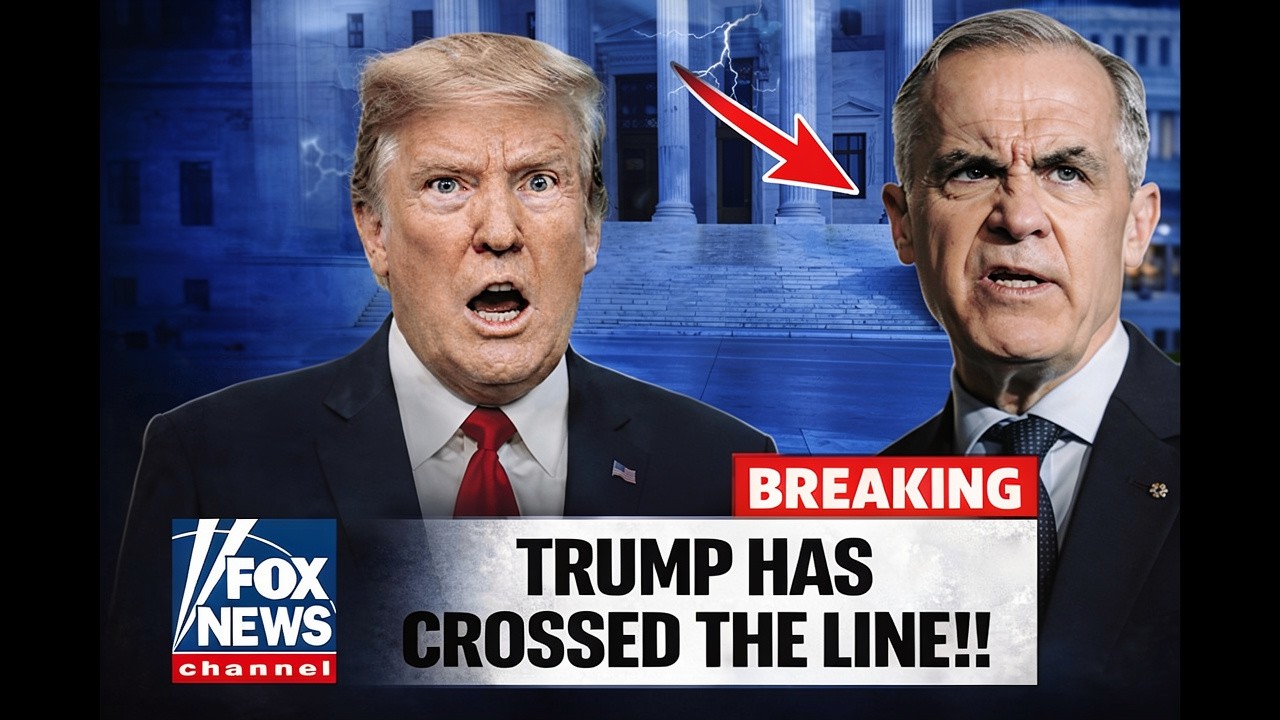
That framing matters. Because once trade is recast as “national security,” it stops being a normal negotiation. It becomes a pressure valve — and tariffs become the weapon.
Now fast-forward to this week: the U.S. House voted to end Trump’s Canada tariffs in a rare bipartisan rebuke, showing cracks inside Washington over how far this approach has gone.
Even if the votes are partly symbolic, the signal is loud: tariff warfare is now splitting the U.S. political system, not just U.S.-Canada relations.
So where does Mark Carney fit into the “cold response” storyline?
The video you shared depicts Ottawa going “silent,” then suddenly appearing in Brussels next to EU leadership — presenting Canada as if it’s building a bypass around the U.S. Whether or not every dramatic claim in that narration is literal, there’s a verified backbone: Carney has been strengthening Canada’s alignment with Europe through formal summits and new partnership initiatives.
Canada and the EU held their 20th summit in Brussels on June 23, 2025, with Carney representing Canada alongside top EU leaders.
Canada’s own government also highlights new Canada–EU collaboration tracks and a strategic partnership push launched in Brussels.
On tech and standards, the EU and Canada already have a digital partnership framework that includes areas like AI, digital identity, cybersecurity, and more — meaning the “standard-setting” battleground isn’t fantasy; it’s active policy terrain.
And on the Pacific angle: while the viral narration paints an 18-month “energy redirection” shock plan, what’s clearly real is that Canada–Asia trade corridors and decarbonized shipping initiatives (Canada–Japan–South Korea) have been under development through consortium work — the concept of a Pacific corridor is not invented, even if the video’s timelines and dramatic market claims may be amplified for effect.
This is why the moment feels like “economic war” even when the footage is pure talk: networks are shifting. And once companies, regulators, and governments build alternate routes — Europe pathways, Pacific corridors, digital standards alignment — those routes don’t vanish just because one crisis cools down.
That’s the real gut-punch for Washington: Canada doesn’t have to “beat” the U.S. in a head-on fight. It only has to prove the U.S. is no longer the only door.
And for ordinary people, the stakes are immediate. If you live anywhere tied to the U.S.-Canada supply chain (autos, manufacturing, agriculture, energy), prolonged instability forces businesses to do the unthinkable: rebuild the map. New suppliers, new ports, new compliance regimes, new investment priorities. Jobs don’t disappear in a single day — they migrate quietly, then never come back.
So did Trump “declare war”?
In the missile-and-tanks sense, no.
But in the legal-and-market sense — invoking emergency logic, weaponizing tariffs, and labeling an ally a threat — it’s understandable why people are using that word. And Carney’s “cold response” isn’t about bravado. It’s about option-building: making sure Canada can still move goods, capital, and influence even if Washington keeps turning the screws.
The scariest part isn’t the shouting.
It’s the restructuring happening underneath it.