🔥 BREAKING: U.S. TIGHTENS ENERGY RESTRICTIONS ON CUBA — CANADA EXPANDS ITS FOOTPRINT 🇺🇸⛽🇨🇦
When President Trump declared this month that Cuba would no longer receive oil or financial support linked to Venezuela, the announcement was framed as a blunt ultimatum to Havana. “There will be no more oil or money going to Cuba. Zero,” he wrote on social media, signaling a sharp escalation in Washington’s effort to isolate the island and tighten control over Venezuelan crude flows.
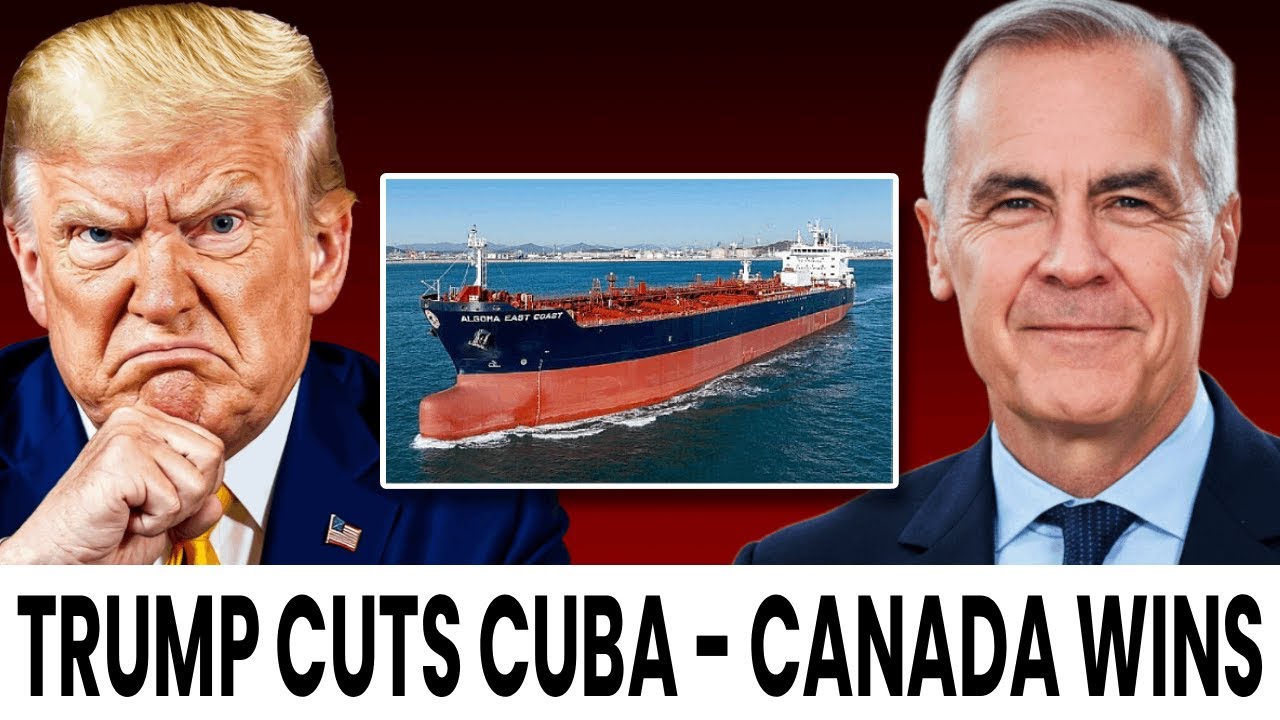
The immediate consequences were felt in Cuba, where the energy system — long dependent on subsidized Venezuelan shipments — strained under the sudden cutoff. Rolling blackouts spread as officials scrambled to secure alternative supplies from Mexico and China, neither of which could fully compensate for the loss.
But beyond the island’s power shortages, the move set off a quieter and potentially more enduring shift in global oil markets. By redirecting Venezuelan crude away from its traditional routes, the Trump administration disrupted a fragile balance in the market for heavy oil — and, in the process, opened an unexpected opportunity for Canada.
For decades, Canada’s oil sands producers have occupied an awkward position in the global energy system. The country holds vast reserves of heavy crude in Alberta, but geography and infrastructure have tethered most exports to the United States. Canadian heavy oil, thick and sulfur-laden, competes directly with Venezuelan grades for refineries specially designed to process such crude. As long as Venezuela remained a meaningful supplier, Canada’s leverage was limited.
Even in decline, Venezuela has mattered. Production, once as high as 3.7 million barrels a day in the 1970s, has fallen to roughly 900,000 barrels per day in recent years. Yet those volumes remained significant for refineries calibrated for heavy crude. China alone imported about 144 million barrels of Venezuelan oil in 2023, accounting for more than two-thirds of Venezuela’s exports. India also relied on Venezuelan supplies to feed its complex refining sector.
The new U.S. restrictions have effectively reshuffled those flows. As Washington sought to assert greater influence over Venezuelan exports and prioritize American refiners, Asian buyers were left to secure replacement barrels in a market where heavy crude is neither abundant nor easily substituted. Unlike lighter oil, heavy grades require specialized equipment; switching feedstocks can be costly and technically challenging.
Enter Canada.
Over the past decade, Canadian policymakers and energy companies have invested heavily in expanding export capacity beyond the United States. The most consequential project, the Trans Mountain pipeline expansion to the Pacific Coast, faced years of legal battles and environmental opposition before becoming operational. Its completion now appears prescient. For the first time, large volumes of Canadian crude can reach Asian markets directly, without passing through American intermediaries.
The appeal to Asian refiners is straightforward. Canada offers political stability, functioning infrastructure and predictable regulation. In a period marked by sanctions on Russia, instability in parts of the Middle East and chronic mismanagement in Venezuela, reliability carries a premium. Canadian oil may lack geopolitical drama, but it arrives on schedule and conforms to specifications.
Prime Minister Mark Carney has underscored the strategic dimension of this moment, describing energy diversification as both an economic necessity and a geopolitical opportunity. Provincial leaders in Alberta have echoed the message, arguing that recent events demonstrate the importance of building infrastructure in multiple directions — south to the United States, west to Asia and potentially east to Atlantic export terminals.

Industry groups, including the Canadian Association of Petroleum Producers, have framed the upheaval as evidence that Canada must remain competitive for energy investment. With Asian refiners signaling interest in long-term supply agreements, producers are positioning themselves to lock in contracts that could endure for years.
Such agreements matter. Once a refinery integrates a particular crude grade into its operations, unwinding that relationship can be expensive and disruptive. Analysts note that when Venezuelan output faltered in the 2000s, U.S. Gulf Coast refineries increasingly turned to Canadian heavy oil — and largely stayed with it even when some Venezuelan production returned.
A similar pattern could now unfold in Asia, but on a larger scale. Venezuela’s infrastructure has deteriorated after decades of underinvestment and sanctions. Its state oil company has estimated that restoring production would require tens of billions of dollars and years of rehabilitation. Even under optimistic scenarios, a swift recovery appears unlikely.
The broader geopolitical implications are significant. China has sought to diversify energy supplies to reduce exposure to maritime chokepoints and unstable regions. India, while pragmatic in its sourcing, has shown interest in suppliers with transparent legal systems and enforceable contracts. Canada, as a democratic producer with established regulatory institutions, fits that profile.
None of this suggests that Canada will displace the United States as its primary customer. American Gulf Coast refineries remain a natural destination for Canadian heavy crude due to proximity and compatibility. The difference is optionality. With expanded pipeline access to tidewater, Canadian producers are no longer dependent on a single market.
The irony is notable. A policy designed to tighten U.S. control over Western Hemisphere energy flows and pressure Cuba has, at least for now, created conditions that strengthen Canada’s hand in Asia. By constraining Venezuelan supply routes, Washington has forced Asian refiners to seek alternatives — and Canada, prepared with infrastructure and stable output, has emerged as a leading candidate.
Whether this realignment proves durable will depend on politics in Caracas, policy decisions in Washington and the pace of global energy transition. For the moment, however, a geopolitical crackdown in the Caribbean has reverberated thousands of miles away, reshaping trade patterns and offering Canada a rare opening in a market long defined by constraint.






